Convert your pool to saltwater - full guide
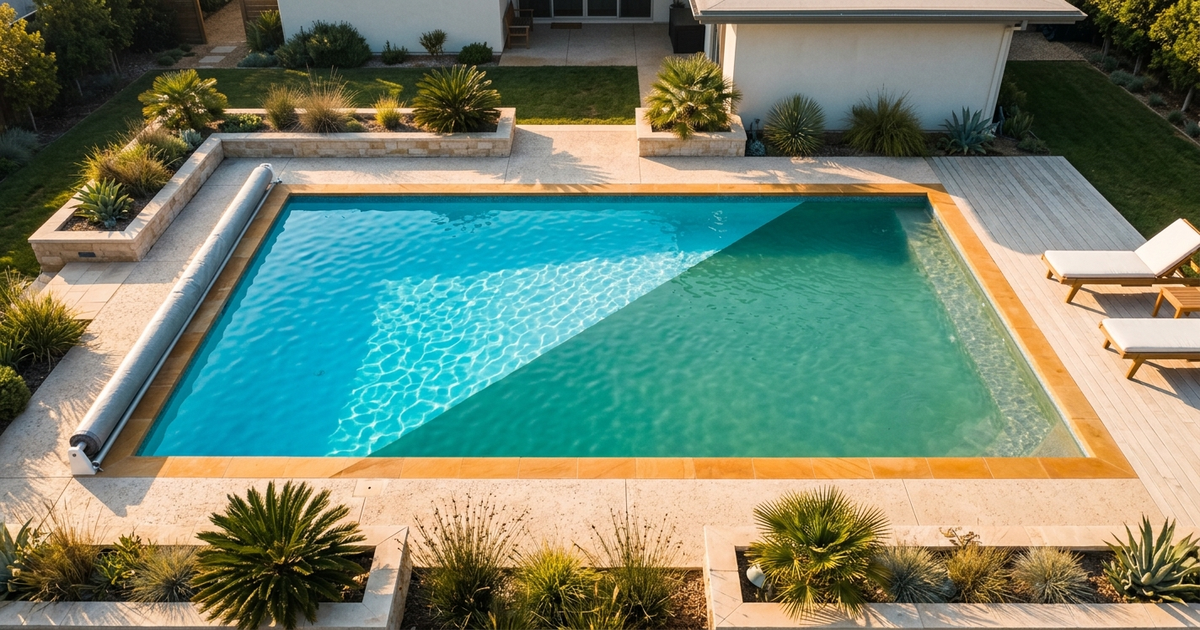
Converting a pool to saltwater means installing a salt chlorine generator (SWG) on the equipment pad, adding 200-300 lbs of pool salt per 10,000 gallons to reach 3,000-3,400 ppm, and adjusting cyanuric acid (CYA) from the traditional 30-50 ppm range up to 60-80 ppm. The work runs 1-2 days for installation plus 24-48 hours for the salt to dissolve. Budget $1,500-$2,500 for a residential SWG installed by a licensed electrician.
The conversion itself is easy. Sizing the cell correctly, testing for metals before you add salt, and treating the first month as a chemistry shakedown — those are where conversions go wrong.
Buy a salt chlorine generator rated for 1.5x your pool's volume. An undersized cell runs at 100% output all summer, shortening its 3-7 year lifespan to 2-3 years. Oversizing by 50% lets the cell cruise at 50-70% output.
I converted my 18,000-gallon vinyl pool in spring 2024. I will walk through what I did, what I would do differently, and the specific decisions that matter. If you are still weighing whether to convert at all, the saltwater vs chlorine cost comparison covers the 5-year math; this article assumes you have decided to convert and want to know exactly how.
Before You Buy Anything: The Compatibility Check
Test for these conditions first. If any one of them flags, address it before you spend a dollar on a salt cell.
| Check | Threshold | What to Do If Flagged |
|---|---|---|
| Copper level | Above 0.2 ppm | Use a metal sequestrant for 2 weeks, retest before converting |
| Iron level | Above 0.2 ppm | Use a metal sequestrant, partial drain if needed |
| Current CYA | Above 80 ppm | Partial drain and refill to bring CYA to 30-50 first |
| Calcium hardness | Above 600 ppm | Partial drain and refill to 250-450 ppm |
| Heater type | Copper heat exchanger | Verify cupronickel or titanium core or skip the heater |
| Coping material | Soft natural stone | Plan on annual sealing or accept slow degradation |
| Pool wall material | Galvanized steel | Convert with caution — salt accelerates corrosion |
| Plaster age | Under 30 days | Wait at least 30 days after a new plaster job |
The metal test is the one most homeowners skip and later regret. Salt at 3,000 ppm acts as an electrolyte, which means copper and iron already dissolved in your water will plate out onto plaster and grout faster than they would in a freshwater pool. Blue-green or rust-brown stains that appear in the first month after conversion are almost always pre-existing metal that the salt finally pushed out of solution. A $15 copper and iron test kit from a pool supply store is cheaper than draining and acid-washing stains later.
For pools that need calcium adjusted before conversion, the calcium hardness guide covers the drain-and-refill math and the difference between calcium chloride and calcium hardness increaser products.
Sizing the Salt Chlorine Generator
Buy an SWG rated for at least 1.5 times your pool's actual volume. This is the single most important purchase decision in a conversion, and the one pool stores get wrong in 3 out of 4 installations because they sell the cell that matches your pool size, not the cell that will last.
A 20,000-gallon pool with a 20,000-gallon-rated cell runs at 80-100% duty cycle all summer and burns out in 2-3 years. The same pool with a 40,000-gallon-rated cell runs at 40-60% duty cycle and lasts 5-7 years. Cells cost $400-$900 to replace; the difference between the right and wrong size at purchase is usually $150-$250.
| Pool Volume | Minimum Cell Rating | Better Cell Rating |
|---|---|---|
| 10,000 gal | 15,000 gal | 20,000-25,000 gal |
| 15,000 gal | 25,000 gal | 30,000-40,000 gal |
| 20,000 gal | 30,000 gal | 40,000 gal |
| 25,000 gal | 40,000 gal | 60,000 gal |
| 30,000 gal | 45,000 gal | 60,000 gal |
I went with a 40,000-gallon-rated unit on my 18,000-gallon pool. Two summers in, the cell runs at 35-50% in peak heat and the controller reports the cell at 96% remaining life. Worth every extra dollar.
How the salt chlorine generator works covers the electrochemistry of the cell and what reverse polarity means if you want the background.
What You Need to Buy
The full conversion kit for a 20,000-gallon residential pool:
- Salt chlorine generator unit (controller + cell, rated for 30,000-40,000 gal): $800-$1,800
- Pool-grade salt, 99.8% sodium chloride, non-iodized, no anti-caking agents (8-12 bags of 50 lb): $80-$160
- Licensed electrician for a dedicated 240V GFCI circuit per NEC Article 680: $300-$600
- Plumbing labor or PVC parts if you do it yourself ($30-$60 in parts, or $150-$300 if hired): varies
- Sacrificial zinc anode for the equipment pad: $30-$60
- Cyanuric acid (granular) to raise CYA into 60-80 ppm range: $25-$50
- Liquid chlorine to maintain sanitization during installation week: $20-$40
- Test kit upgrade if your current one does not include a salt test: $30-$60
Total typical out-of-pocket: $1,500-$2,500. If your equipment pad has no nearby panel space and the electrician has to run a long conduit or upgrade your main panel, that number can push past $3,000.
The cell rating, the brand, and the duty cycle calculations vary by manufacturer. Read the manual for your specific unit before installation — Pentair, Hayward, CircuPool, and CompuPool each spec slightly different salt targets and flow requirements.
The Step-by-Step Conversion
This sequence assumes a residential in-ground pool with an existing pump and filter, and that you have already completed the compatibility check above. Test first, every step.
Step 1: Balance the Existing Water
Before you install anything, get the water into the SWG target range with traditional chemicals. Use a fresh DPD or FAS-DPD test kit — the water testing guide covers which kit to buy if yours is more than a year old or strip-only.
- Free chlorine: 3-5 ppm
- pH: 7.4-7.6
- Total alkalinity: 70-90 ppm (low end of normal)
- Calcium hardness: 250-450 ppm
- CYA: starting at 30-50 ppm is fine — you will raise it later
Step 2: Install the Salt Cell and Electrical
Hire a licensed electrician. The salt cell controller needs a dedicated 240V GFCI circuit per National Electrical Code Article 680, and SWG installations are a common failure point on home inspections when done by unlicensed labor. The cell housing itself plumbs into the return line after the heater (or after the filter if there is no heater), wired into the PVC with two unions so the cell can be removed for inspection.
Mount the controller within 5-6 feet of the cell, out of direct sun if possible, and at eye level on the pad. Most controllers come with a 15-foot cell cable — do not extend it, the voltage drop affects chlorine output.
Step 3: Add Pool Salt
With the pump running, broadcast pool salt across the deep end while walking the perimeter. Pool-grade salt is 99.8% sodium chloride with no iodine, no anti-caking agents (yellow prussiate of soda will stain), and no rust inhibitors. Solar salt and water softener salt work if labeled 99.8% pure or higher.
For a freshwater pool starting at 0 ppm salt, the math is: lbs of salt = pool volume in gallons × target ppm ÷ 120,000. A 20,000-gallon pool to 3,200 ppm needs 533 lbs of salt — 11 bags of 50 lb. The salt calculator guide shows the formula for partial fills and makeup additions.
Brush the bottom of the pool to dissolve the salt faster, and run the pump 24-48 hours before turning on the cell. Adding salt while the SWG is powered can damage the cell with undissolved crystals.
Step 4: Raise CYA to 60-80 ppm
Once the salt has dissolved and the SWG is running, raise cyanuric acid from your starting level into the 60-80 ppm SWG range. To raise CYA by 20 ppm in a 10,000-gallon pool, add 2.6 lbs of granular CYA — the standard ratio is 13 oz per 10 ppm per 10,000 gallons.
Granular CYA dissolves slowly. Put it in a clean sock, tie the sock to the skimmer basket, and let it dissolve over 4-7 days while the pump runs. Do not add CYA directly to the skimmer or you will get white residue on the floor and an unbalanced reading for two weeks.
Step 5: Power Up the Cell and Set the Duty Cycle
Turn on the SWG at 50% output the first day. Test free chlorine 24 hours later. If FC is below 3 ppm, raise the cell to 70%. If FC is above 7 ppm, drop the cell to 30%. The goal is to find the duty cycle that holds FC at 4-6 ppm with the cell running 6-8 hours a day on your normal pump schedule.
This is iterative. Plan on 1-2 weeks of small adjustments before you settle on the steady-state output. Saltwater pools generate chlorine on a schedule tied to pump runtime — the pump run time guide covers how to set that schedule for your pool size and climate.
The First Month: What to Watch
Conversion is not a one-and-done. The first 4-6 weeks are when chemistry stabilizes and small problems become big ones if you ignore them.
| Week | What to Test | What to Watch For |
|---|---|---|
| 1 | FC daily, pH every 3 days, salt level | Cell output matching settings; salt above 2,700 ppm |
| 2 | FC every 2 days, pH every 3 days, TA, CH | pH drift upward; FC stable at 4-6 ppm |
| 3 | Full panel including CYA | CYA in 60-80 ppm range; FC tracking with CYA |
| 4 | Full panel, inspect cell visually | First sign of calcium scale on plates |
| 6 | Full panel, normal maintenance rhythm | Settled into weekly testing cadence |
The two failure modes I see repeatedly in new conversions are pH drift and chasing chlorine. SWGs are net pH neutral over a full chemistry cycle, but the chlorine generation at the cell off-gasses CO2, which pushes pH upward 0.2-0.4 units per week on most pools. Hold total alkalinity at 70-80 ppm (low end of range) and plan on adding muriatic acid every 1-2 weeks.
Chasing chlorine usually means CYA is wrong. If FC drops faster than the cell can replace it, check CYA — 30 ppm CYA in a saltwater pool means UV burns chlorine off as fast as the cell makes it. Raise CYA to 70 ppm and the cell suddenly keeps up at 40% duty cycle instead of 80%.
Common Conversion Mistakes
Five mistakes show up over and over in saltwater conversions.
Undersized cell. Discussed above. Buy 1.5x your pool volume minimum. If a pool store quotes you a cell that exactly matches your gallons, walk out and order online from a manufacturer with a longer warranty.
Iodized table salt or water softener salt with additives. Read the bag. 99.8% sodium chloride minimum, no iodine, no anti-caking agents, no rust inhibitors. Pool salt is the safest choice; food-grade or solar salt works if the label is clean.
Skipping the metals test. A copper level of 0.3 ppm in freshwater is invisible. The same level in saltwater stains plaster within weeks. Test first, sequester if needed, then convert.
CYA stuck at 40 ppm. New saltwater pool owners assume their existing CYA is fine. It is not — the SWG needs the higher 60-80 ppm range to operate efficiently. Plan to raise CYA as part of the conversion, not as an afterthought.
Acid washing the cell on day 30. Modern reverse-polarity cells stay clean for the first 6-12 months. Acid washing a clean cell strips the titanium coating and shortens cell life by years. Only acid wash when you see visible white calcium scale between the plates.
Safety Notes
Three categories of risk to handle before you start.
Electrical. The salt cell controller needs a dedicated 240V GFCI circuit per NEC Article 680. Hire a licensed electrician — not a handyman, not yourself unless you are a licensed electrician. Pool electrical failures are a documented drowning hazard, and home insurance will not cover damages from unpermitted work.
Chemical handling. Pool salt is benign, but the chemicals you will use during conversion are not. Wear chemical-resistant goggles and gloves when handling muriatic acid, granular CYA, and liquid chlorine. Never mix different pool chemicals — chlorine and acid combined release toxic chlorine gas. Always add chemical to water, never water to chemical. Store all chemicals in their original labeled containers, in a cool dry place, with acids stored separately from chlorine products.
Metals and stains. Test copper and iron levels before adding salt. Salt at 3,000 ppm is an electrolyte that pushes dissolved metals out of solution and onto plaster, grout, and fiberglass surfaces. A pre-conversion metal sequestrant treatment costs $15-$30 and prevents stains that would otherwise cost hundreds to remove.
After Conversion: The New Maintenance Rhythm
Once the first month settles, saltwater maintenance is genuinely lighter than traditional chlorine — but the equipment becomes the thing you watch. The saltwater pool guide covers the steady-state maintenance schedule including weekly testing, quarterly cell inspection, and the targets that differ from traditional pools.
If you are tracking chemistry on paper, the math changes after conversion: free chlorine targets scale with CYA, and a saltwater pool at 70 ppm CYA needs 4-7 ppm FC instead of the 3-5 ppm you ran before. The Poolably app has a saltwater mode that switches the target ranges and dosage math automatically when you set your pool type — useful for the first few months when the new numbers are not yet automatic. Available for iOS. If you only test weekly and prefer to do the math by hand, a printed chlorine-CYA chart taped inside your pool shed works just as well.
Frequently Asked Questions
How long does it take to convert a pool to saltwater? Hands-on work runs 1-2 days — a licensed electrician needs 2-4 hours for the dedicated 240V GFCI circuit, and another 2-3 hours for the plumbing cut-in. After that, 24-48 hours for the salt to dissolve and 4-6 weeks for chemistry to settle into a stable rhythm.
How much salt do I need to convert my pool? Plan on 200-300 lbs of pool-grade salt per 10,000 gallons to reach the 3,000-3,400 ppm operating range. For a 20,000-gallon pool that is 8-12 bags of 50 lb pool salt, costing $80-$160 total.
Can I install a salt chlorine generator myself? You can do the plumbing portion if you are comfortable cutting PVC and threading unions. The electrical portion requires a licensed electrician per NEC Article 680 — the cell controller needs a dedicated 240V GFCI circuit, and pool electrical work is one of the most heavily inspected categories of home electrical for liability reasons.
Will my existing pool heater work with saltwater? Probably, but check first. Older heaters with bare copper heat exchangers corrode in saltwater within 1-3 years. Modern heaters with cupronickel or titanium heat exchangers (most units built after 2015) handle saltwater without issue. Pentair MasterTemp HD and Hayward Universal H-Series cupronickel models are rated for saltwater pools.
Do I need to change my pool filter or pump for saltwater? No. Saltwater does not damage the filter media, the pump motor, or the filter housing. The only equipment changes are adding the SWG itself and replacing any galvanized steel rails, ladders, or fittings with stainless steel.
How much does it cost to convert a pool to saltwater in 2026? Budget $1,500-$2,500 for a complete residential conversion including the SWG unit ($800-$1,800), licensed electrician for the dedicated circuit ($300-$600), pool salt ($80-$160), and miscellaneous parts and chemicals. Add $500-$1,000 if your equipment pad needs significant electrical work or a heater replacement.
Frequently Asked Questions
Vlad Kuzin
Pool owner and builder of the Poolably app. I got tired of guessing at chemical doses, so I built a calculator that does the math.