Pool Calcium Hardness: How to Test, Raise, and Lower It
Calcium hardness is the measure of dissolved calcium in your pool water, and it should sit between 200 and 400 ppm for plaster pools, or 150 to 250 ppm for vinyl and fiberglass. Below that range, the water becomes corrosive and starts dissolving calcium out of plaster, grout, and concrete to balance itself. Above 400 ppm — especially with high pH or high alkalinity — calcium precipitates out and deposits as white scale on tile lines, heater elements, and salt chlorine generator cells.
Most people ignore calcium hardness until they see the damage. The fix is not complicated, but the direction matters: raising calcium takes a single bucket of calcium chloride and 24 hours, while lowering it requires draining and refilling part of the pool.
What Calcium Hardness Actually Does
Pool water wants to be in chemical equilibrium. If it does not have enough dissolved calcium, it will pull calcium from anywhere it can — plaster, tile grout, the cement in concrete decking, and the metal in heaters. That is etching. The surface gets rough, then pitted, then starts shedding flakes into the water. Plaster repair from extended low-calcium operation runs $4,000 to $8,000 for a typical residential pool.
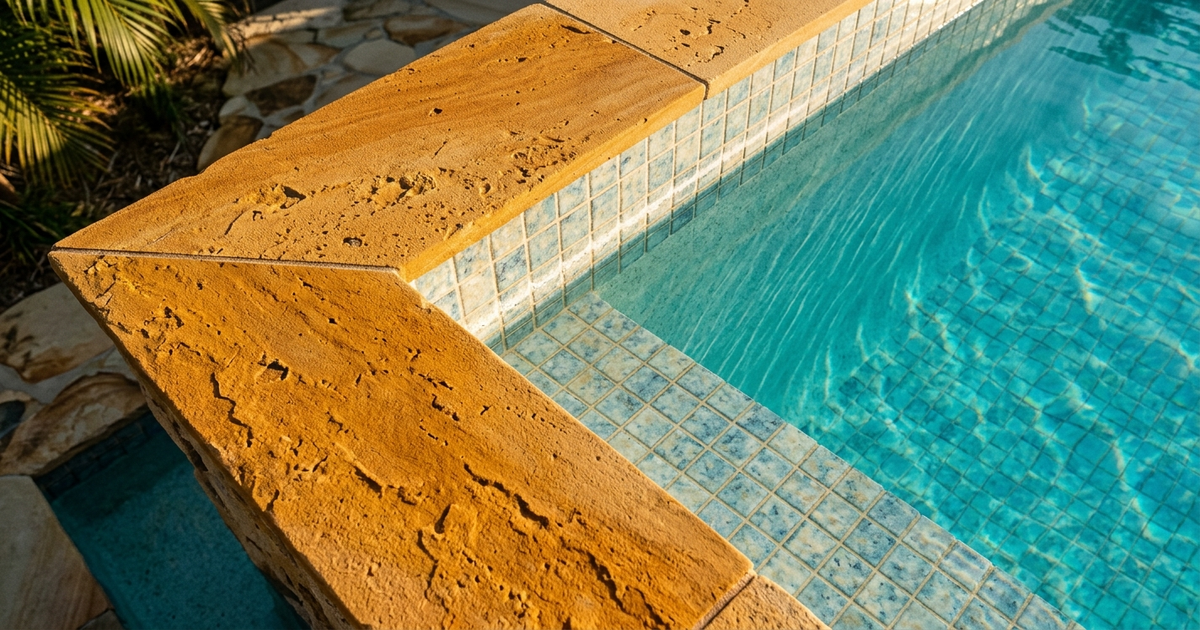
The opposite problem is scaling. When calcium hardness is too high and pH or alkalinity climbs, calcium carbonate falls out of solution and crystallizes onto whatever surface is handy. The first place you notice it is the tile line — a hard, white-gray crust that does not come off with regular brushing. It also coats heater coils (reducing efficiency by 20 to 40 percent before failure), narrows the openings on salt cell plates (cutting chlorine output), and makes the water look perpetually cloudy.
The trick is that calcium alone does not cause either problem. The chemistry that determines whether your water etches or scales depends on calcium, pH, alkalinity, temperature, and total dissolved solids together. That combined measure is the Langelier Saturation Index.
The Langelier Saturation Index in Plain English
The Langelier Saturation Index (LSI) is a single number that tells you whether your water is corrosive, balanced, or scaling. The full formula uses water temperature, pH, calcium hardness, alkalinity, and total dissolved solids, but the practical version pool owners need to know is this:
- LSI below −0.3 → water is corrosive. It will etch plaster and dissolve metal.
- LSI between −0.3 and +0.3 → balanced. This is the target.
- LSI above +0.3 → water is scaling. Calcium will deposit on surfaces.
You do not have to memorize the formula. What matters is that calcium hardness is one of five levers that move the index. If your pH or alkalinity is high and you cannot bring them down (common after a heavy chlorine cycle or a fresh fill), you can pull the LSI back into range by adjusting calcium hardness downward. If your pH is low and your water feels aggressive, raising calcium hardness is the fastest fix.
| Lever | Increase Pushes LSI | Decrease Pushes LSI |
|---|---|---|
| pH | Toward scaling | Toward corrosive |
| Total alkalinity | Toward scaling | Toward corrosive |
| Calcium hardness | Toward scaling | Toward corrosive |
| Water temperature | Toward scaling | Toward corrosive |
| Cyanuric acid | Toward corrosive | Toward scaling |
Two of those levers — pH and alkalinity — move quickly and respond to standard chemical adjustments. pH balance and alkalinity management are the day-to-day knobs. Calcium hardness is the long-cycle lever: you adjust it a few times a season, and it stays where you put it unless your fill water or shock product is changing it for you.
Target Calcium Hardness by Pool Type
| Pool Type | Target CH (ppm) | Why |
|---|---|---|
| Plaster, concrete, gunite, or pebble | 250 to 400 | Protects calcium-bearing surfaces from etching |
| Vinyl liner | 150 to 250 | No plaster to protect, but heater still needs balance |
| Fiberglass | 150 to 250 | Same as vinyl — heater protection is the limit |
| Saltwater (any surface) | 250 to 350 | Salt cells scale at the high end of the range |
| Indoor pool | Same as outdoor for surface type | No evaporation concentration, but check fill water |
The CDC Model Aquatic Health Code sets a minimum of 150 ppm for any pool to prevent corrosion of the pool and circulation equipment. The Pool & Hot Tub Alliance publishes 200 to 400 ppm as the ideal operating range for residential pools. Pool builders often spec higher minimums (300+ ppm for new plaster pools during the first year of curing) — if you have a builder's startup document, follow that until the plaster cures, then settle into the 250 to 400 ppm range.
Calcium Hardness Too Low: How to Raise It
Calcium hardness is raised with calcium chloride, sold at pool supply stores as "calcium hardness increaser," "calcium plus," or simply "calcium chloride." It comes in two common forms:
- Anhydrous calcium chloride (94 to 97% pure flake) — dissolves fast, generates significant heat
- Calcium chloride dihydrate (CaCl₂·2H₂O) — less concentrated, dissolves more slowly, generates less heat
The dihydrate is more common at retail and is what most homeowners end up with. Either form works. Just use the right dose for the product on hand.
Calcium Chloride Dosage Table
Test your current calcium hardness first. Use the table to calculate how much product to add per 10,000 gallons.
| CH Increase Needed | Anhydrous CaCl₂ (per 10,000 gal) | Dihydrate CaCl₂·2H₂O (per 10,000 gal) |
|---|---|---|
| +10 ppm | 1.25 lbs | 1.7 lbs |
| +20 ppm | 2.5 lbs | 3.4 lbs |
| +30 ppm | 3.75 lbs | 5.1 lbs |
| +40 ppm | 5 lbs | 6.8 lbs |
| +50 ppm | 6.25 lbs | 8.5 lbs |
These figures are general guidelines based on standard calcium chloride concentrations. Specific products vary slightly with purity, so always check the dosage chart on your product label if one is provided.
For pools larger or smaller than 10,000 gallons, multiply proportionally. A 20,000-gallon pool needing +30 ppm using dihydrate flake needs 10.2 lbs.
Step-by-Step Procedure
Do not add more than 10 ppm equivalent per treatment. Calcium chloride is exothermic — it generates significant heat when it hits water, and large doses in one shot can crack a plastic bucket or scald skin.
- Test calcium hardness with a drop-based kit. Strips are fine for ballpark, but for dosage calculations you want a titration result. The Taylor K-2006, LaMotte ColorQ, or a similar calcium hardness test kit gives a reading within ±10 ppm. Test pH and alkalinity at the same time so you understand where the LSI sits before changing anything.
- Calculate the dose for a single 10 ppm step. Even if you need to raise calcium hardness by 80 ppm, plan to do it in eight passes over a week — not one giant dump. Single-shot dosing of more than 10 ppm in soft water has cracked plaster in cold-fill pools.
- Pre-dissolve in a bucket of cool water. Fill a 5-gallon bucket two-thirds with pool water first, then slowly pour in the measured calcium chloride. Always add chemical to water, never water to chemical — pouring water onto dry calcium chloride flake produces a steam burst. Stir with a wooden or plastic stake until fully dissolved. The bucket will get hot to the touch within seconds.
- Pour around the pool perimeter with the pump running. Walk slowly around the deep end and distribute the solution evenly. Keep the pump running for at least 4 hours after dosing to mix.
- Wait 24 hours. Retest calcium hardness, pH, and alkalinity. If you need more, repeat. Calcium chloride raises calcium hardness immediately, but the reading stabilizes after a full circulation cycle.
Wear chemical-resistant goggles and gloves whenever you handle calcium chloride. Store the bag sealed in its original container in a cool dry place — calcium chloride is hygroscopic, meaning it pulls water out of the air and turns into a sticky brine if left open. Keep it separated from other pool chemicals, especially chlorine products and pH chemicals.
Calcium Hardness Too High: How to Lower It
There is no chemical that removes calcium from pool water. No flocculant, no clarifier, no enzyme. The only reliable methods are dilution with low-calcium water or, in extreme cases, reverse osmosis treatment performed by a specialty service.
Dilution: The Math
Percentage of pool to drain and refill = (Current CH − Target CH) ÷ (Current CH − Fill Water CH) × 100
Example 1: Current CH 600 ppm, target 300 ppm, fill water 100 ppm. (600 − 300) ÷ (600 − 100) × 100 = 60 percent. Drain and refill 60% of the pool volume.
Example 2: Current CH 800 ppm, target 350 ppm, fill water 200 ppm. (800 − 350) ÷ (800 − 200) × 100 = 75 percent. Drain and refill three-quarters of the pool.
Example 3: Current CH 500 ppm, target 300 ppm, fill water 50 ppm. (500 − 300) ÷ (500 − 50) × 100 = 44 percent. Drain and refill a little under half.
Notice that fill water matters. If your tap water is already at 300 ppm calcium hardness (common in much of the Southwest and parts of Florida), you cannot dilute your way to 300 ppm — the math breaks down because the denominator becomes zero or negative. In that case, the only options are (a) fill with a different water source, or (b) accept the higher CH and manage pH and alkalinity tightly to keep the LSI in range.
Drain and Refill in Stages
Never drain a pool completely without engineering it. Hydrostatic pressure from groundwater can lift a fiberglass or vinyl pool out of the ground, and plaster shells can crack from sudden load changes. Drain 25 to 30 percent of the pool at a time, refill, then drain again if more dilution is needed.
- Check your local discharge rules. Most municipalities require pool water to be dechlorinated (free chlorine below 0.1 ppm) before draining to storm drains or municipal sewer. Let chlorine dissipate naturally over 2 to 3 days with the cover off, or neutralize with sodium thiosulfate.
- Lower the water by 25 to 30 percent using a submersible pump or the multiport drain setting on a sand filter.
- Refill from your fill source and run the pump for 24 hours to mix.
- Test the full chemistry panel before draining again. Dilution lowers everything proportionally — pH, alkalinity, CYA, and calcium hardness all drop. If the first drain hit the target, stop and rebalance.
- Repeat as needed. Three rounds of 25 percent dilution lowers calcium hardness by approximately 58 percent (assuming low-CH fill water). Four rounds gets you to about 68 percent.
When to Call a Reverse Osmosis Service
If your fill water is already over 300 ppm calcium and your pool is at 700+ ppm, dilution will not get you to a workable range. A mobile reverse osmosis service can process pool water on-site, removing calcium, sodium, and dissolved solids without draining. Cost runs $400 to $800 for a residential pool — pricier than a drain, but it does not waste water and works regardless of fill source. This is the standard fix in Phoenix, Las Vegas, and other hard-water markets where calcium accumulation is unavoidable.
What Drives Calcium Hardness Up Over Time
If you have never added calcium chloride and your CH keeps climbing, three things are doing it for you:
Cal-hypo shock. Calcium hypochlorite (cal-hypo, the most common pool shock) is 65 to 75 percent available chlorine and 27 to 33 percent calcium by weight. Every 1 ppm of free chlorine you add through cal-hypo adds approximately 0.7 ppm of calcium hardness. A pool shocked weekly with cal-hypo during summer can pick up 100 to 150 ppm of calcium over a season. Switching to liquid chlorine (sodium hypochlorite) eliminates this entirely — liquid chlorine adds zero calcium.
Evaporation. When water evaporates from your pool, calcium does not leave with it. Every gallon that evaporates and gets topped off with fresh tap water concentrates the calcium already in the pool. In a hot dry climate, a pool can lose 1/4 inch of water per day to evaporation — about 150 gallons in an average 14×28 foot pool. Over a month, that adds the calcium content of 4,500 gallons of fill water without removing any of the original.
Hard fill water. Municipal water hardness varies wildly. Southwest cities (Phoenix, Las Vegas, Tucson) commonly supply water at 250 to 400 ppm hardness. Northeast cities (Boston, NYC) deliver water at 30 to 80 ppm. Check your water utility's annual water quality report for hardness data, or test a sample of fresh tap water directly with your pool kit.
I have a 22,000-gallon plaster pool, and during my first year I shocked with cal-hypo every Sunday because that is what the pool store handed me. By August, my calcium hardness was 540 ppm and the tile line had a white film I could not scrub off. I switched to 12.5% liquid chlorine, drained and refilled 40% of the pool, and stopped using cal-hypo entirely. The next season, calcium hardness held steady around 320 ppm with no intervention.
Calcium Hardness in Saltwater Pools
Salt chlorine generators do not add calcium directly. The chlorine they produce is sodium hypochlorite, the same compound as liquid chlorine. But saltwater pools tend to drift higher on calcium hardness for two indirect reasons.
First, the high pH characteristic of SWG operation pushes the LSI toward scaling. The generator's electrolysis process produces sodium hydroxide as a byproduct, which raises pH. Combined with even moderate calcium hardness, this is what causes the white scale buildup inside the salt cell that owners have to acid-clean every 3 to 6 months.
Second, saltwater pool owners often have hard fill water in the same regions where salt pools are popular (the Southwest, Florida). The fill water adds calcium that the generator does nothing to remove.
For a saltwater pool, target the lower half of the calcium hardness range — 250 to 350 ppm — and keep pH below 7.8 to slow cell scaling. Brush the tile line weekly. The cloudy water from calcium scaling is hard to clear once it gets going, so prevention through tight pH control is cheaper than treatment.
The Poolably app tracks calcium hardness over time alongside your other chemistry readings and alerts when it drifts outside the 200 to 400 ppm range. The dosage calculator uses your actual pool volume and the calcium chloride product type you have on hand, so you do not have to do the conversion math by hand. It is iOS only, and it does not replace testing — you still need a drop-based test kit or strips to enter readings. If you only adjust calcium hardness once or twice a season, the math in this article is enough to do it with a calculator app and a notepad. The app earns its keep when you are tracking five parameters across an entire pool season and want the dosing math, drift alerts, and history in one place.
Frequently Asked Questions
What is the ideal calcium hardness level for a pool?
For plaster, concrete, and gunite pools, calcium hardness should sit between 200 and 400 ppm. For vinyl and fiberglass pools, 150 to 250 ppm is fine. Saltwater pools tend to drift higher and should be tested monthly.
How much calcium chloride do I add to raise calcium hardness?
Test your current calcium hardness first. To raise calcium hardness by 10 ppm in a 10,000-gallon pool, add about 1.25 lbs of anhydrous calcium chloride or 1.7 lbs of calcium chloride dihydrate. Pre-dissolve in a bucket of cool water, pour around the pool edge with the pump running, and wait 24 hours before retesting.
What causes calcium hardness to get too high?
The two biggest sources are hard tap water and calcium hypochlorite shock (cal-hypo). Every 1 ppm of free chlorine added through cal-hypo also adds about 0.7 ppm of calcium hardness. Evaporation concentrates whatever calcium is already in the pool, while rain and splash-out do not remove it.
How do I lower calcium hardness in my pool?
Drain a portion of the pool and refill with low-calcium water. To drop from 600 ppm to 300 ppm using fill water at 100 ppm, you need to replace about 60 percent of the pool volume. Drain in stages of 25 to 30 percent at a time to avoid hydrostatic damage to the shell. If your fill water is already over 300 ppm, dilution cannot reach a low target and you may need reverse osmosis service.
Is calcium hardness the same as total hardness?
No. Total hardness includes both calcium and magnesium. Pool test kits measure calcium hardness specifically, because calcium is the ion responsible for scaling and plaster damage. If you use a tap water hardness reading from your municipality, multiply by about 0.75 to estimate calcium hardness.
Do I need calcium hardness in a vinyl or fiberglass pool?
Yes, but the target is lower. Vinyl and fiberglass pools do not have calcium-bearing surfaces to protect, so you can run calcium hardness as low as 150 ppm. The heater, however, still needs balanced water. Calcium hardness below 100 ppm in any pool will start pulling calcium out of heat exchangers and concrete decking. Keep it at or above 150 ppm even if your pool surface does not require it.
Why does my pool need more calcium when I use a salt system?
Salt chlorine generators raise pH as a byproduct of electrolysis. High pH pushes the Langelier Saturation Index toward scaling, and the calcium that gets deposited builds up on the salt cell plates. Counterintuitively, the fix is not less calcium — it is tighter pH control. Keep pH below 7.8 with weekly muriatic acid additions and target calcium hardness around 300 ppm.
Frequently Asked Questions
Vlad Kuzin
Pool owner and builder of the Poolably app. I got tired of guessing at chemical doses, so I built a calculator that does the math.