Pool filter cleaning - sand, cartridge, and DE
Clean your pool filter when the pressure gauge reads 8 to 10 psi above its clean baseline, not on a fixed schedule. Sand filters get backwashed. Cartridge filters get hosed and chemically soaked. DE filters get backwashed and then recharged with fresh diatomaceous earth. Skip the wrong procedure for your filter type and you either ruin the filter or push dirty water back into the pool.
The pressure gauge on top of the filter is the only signal that matters. Mark the reading right after you clean — that is your clean baseline. When the gauge climbs 8 to 10 psi above that number, the filter is loaded and flow is choked. Most residential pools hit that point every 2 to 6 weeks in season, but a heavy bather load, a pollen storm, or an algae bloom can do it in a day.
Write your clean baseline on the tank with a paint pen. Note the pressure right after every cleaning so you never have to guess when 8-10 psi above baseline hits. No baseline means no way to know when the filter actually needs service.
Which Filter Do You Have
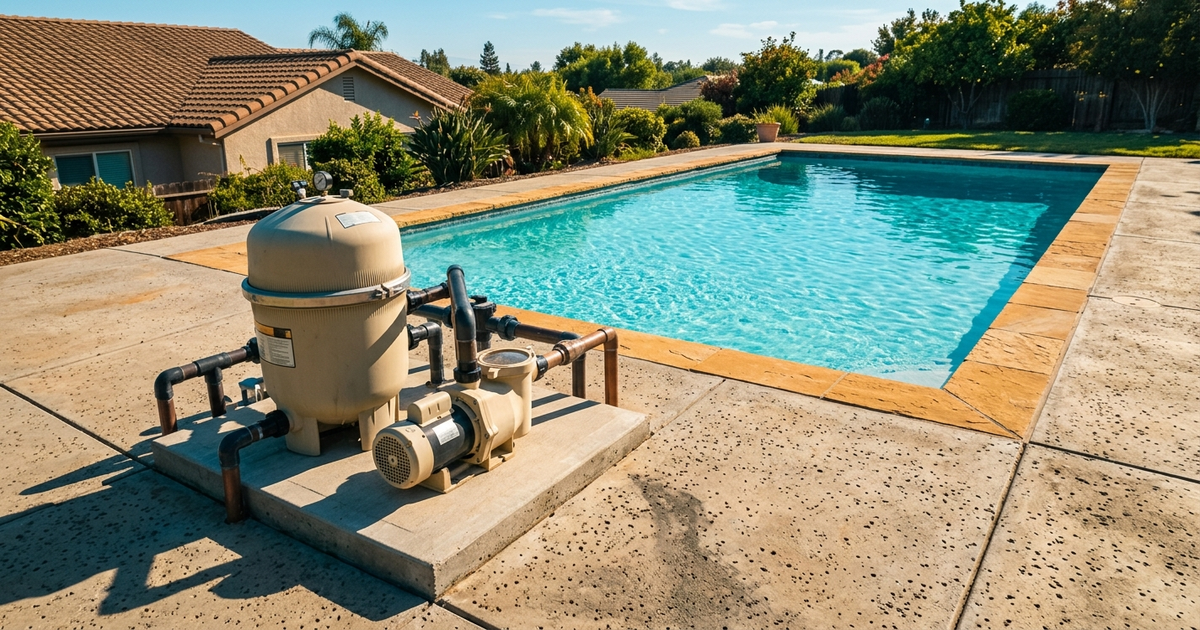
Walk to the equipment pad and look at the tank shape. A sand filter is a tall, dome-topped tank with a single pipe running to a multiport valve on the side or top. A cartridge filter is a squatter cylinder with a clamped or bolted lid you can pop off to pull out the pleated cartridge. A DE filter looks similar to a cartridge filter or sand filter from the outside but has a backwash valve and either internal grids (vertical-grid DE) or pleated elements (Quad DE / cartridge-style DE).
If you cannot tell from the outside, look at the label. The manufacturer plate will say "sand," "cartridge," or "DE," along with the filter area in square feet and the recommended flow rate.
| Filter Type | What's Inside | Cleaning Method | Clean Baseline Pressure |
|---|---|---|---|
| Sand | 100–300 lbs of #20 silica sand | Backwash + annual chemical clean | 10–15 psi |
| Cartridge | 1 to 4 pleated polyester cartridges | Hose rinse + chemical soak | 8–12 psi |
| DE | Fabric grids coated with diatomaceous earth | Backwash + recharge with fresh DE | 10–15 psi |
The clean baseline varies by pump size, plumbing, and elevation. Your gauge reading right after a fresh cleaning is your baseline — write it on the tank with a paint pen so you do not have to guess later.
Sand Filter: Backwashing Step by Step
A sand filter traps dirt in the top inch or two of the sand bed. Backwashing reverses the flow so trapped debris flushes out the waste line. The sand itself is not replaced during a backwash — it stays in the tank for 5 to 7 years before the grains become too rounded to filter effectively.
Backwash when the pressure climbs 8 to 10 psi above clean baseline, or about every 2 to 6 weeks during the swim season.
Step-by-step:
- Test the water first. A dirty filter is sometimes a symptom of an underlying chemistry problem — high pH precipitating calcium, or an algae bloom feeding particulate. If you have cloudy water, check the pool water chemistry guide before assuming the filter is the cause.
- Shut off the pump. Never move a multiport valve handle with the pump running — the internal spider gasket can tear and you will get sand bypassing into the pool.
- Turn the multiport valve to BACKWASH and lock it down.
- Open the waste line (or roll out the backwash hose) and confirm it is directing water away from the pool, the gas meter, and any plants you care about. Backwash water may contain pool chemicals — follow local codes for disposal.
- Turn the pump back on. Watch the sight glass on the valve. The water will be brown or green at first.
- Run for 2 to 3 minutes until the sight glass runs clear.
- Shut off the pump. Move the valve to RINSE.
- Turn the pump back on for 30 to 60 seconds. This settles the sand bed so debris does not blow back into the pool when you start filtering again.
- Shut off the pump. Move the valve back to FILTER. Close the waste line.
- Turn the pump on and note the new clean baseline pressure. Top off the pool water level — backwashing typically dumps 200 to 500 gallons.
Sand filters also need a chemical clean once a year. Oils, fine particulate, and biofilm build up between the grains where backwashing cannot reach. A sand filter cleaner with a chelating agent, poured into the skimmer and left to soak overnight with the pump off, breaks up the buildup. Backwash the next morning.
Replace the sand every 5 to 7 years. Worn sand looks the same on top but the grains have rounded and smoothed, so they no longer trap fine particulate.
Cartridge Filter: Hosing and Chemical Soaking
Cartridge filters trap debris on a pleated polyester element. There is no backwash — you pull the cartridge out, hose it off, and put it back. Most cartridge filters have a single large cartridge in small pools or 4 stacked cartridges in larger systems.
Rinse every 4 to 6 weeks. Chemical soak every 3 to 6 months. Replace every 1 to 3 years.
Quick rinse procedure (every 4 to 6 weeks):
- Shut off the pump.
- Release pressure by lifting the air relief valve on top of the filter housing. Wait until water dribbles out and air stops hissing. Skipping this step is how people get sprayed with a face full of pressurized water.
- Open the housing. Unclamp the band clamp or unscrew the lid bolts. Pull the cartridge straight up.
- Hose the pleats from top to bottom, getting the spray nozzle into the gap between each pleat. Work all the way around the cartridge.
- Inspect the cartridge. Look for tears in the fabric, separation between the fabric and the end caps, and matted pleats that do not open up. Any of those means it is time to replace.
- Reinstall the cartridge and the lid. Lubricate the lid O-ring with silicone-based pool lube only — petroleum products degrade the rubber.
- Start the pump, open the air relief until water sprays out, then close it. Note the new clean baseline pressure.
Chemical soak procedure (every 3 to 6 months):
A garden-hose rinse does not remove oils, sunscreen, and mineral scale. Twice a year, do a full chemical clean.
| Buildup Type | Solution | Dilution | Soak Time |
|---|---|---|---|
| Oils, sunscreen, lotion (gray slime) | Trisodium phosphate (TSP) | 1 cup per 5 gallons of water | 8 to 12 hours |
| Calcium scale (white crust) | Pool filter cleaner with diluted acid | Per label — typically 1 qt per 5 gallons | 1 hour |
| Both | Degrease first, rinse, then acid | See above | Sequential |
Soak the cartridge fully submerged in a clean trash can or 5-gallon bucket. Rinse with a garden hose until no foam comes off, then let it dry before reinstalling.
A few rules learned the hard way. Never use household bleach — it shortens the cartridge life by years. Never use straight muriatic acid — it eats the polyester and the end caps. Never skip the degrease step before acid — acid on oils creates a tarry layer that locks debris in permanently.
If you have two sets of cartridges, you can rotate them. Pull one set, drop in the spare, and chemical-soak the dirty set on your own schedule. The filter is back in service in 15 minutes instead of overnight.
DE Filter: Backwashing and Recharging
DE filters use fabric grids coated with diatomaceous earth — a fine powder made of fossilized algae shells. The DE coating is what does the actual filtering, down to particles as small as 3 to 5 microns. After backwashing, the DE flushes out with the dirty water and you have to recharge the filter with fresh DE.
Backwash and recharge when the pressure rises 8 to 10 psi above clean baseline, typically every 4 to 6 weeks.
Step-by-step:
- Test the water first and confirm chemistry is in range. A DE filter that clogs within days of a cleaning usually means an algae bloom or excess particulate from over-shocking.
- Shut off the pump.
- Turn the multiport valve to BACKWASH (or pull the backwash valve plunger on a push-pull style filter).
- Open the waste line. DE backwash water contains diatomaceous earth — do not drain it onto a lawn you care about, and check local codes.
- Turn the pump on for 2 to 3 minutes until the sight glass runs clear.
- Shut off the pump. Move the valve to RINSE for 30 to 60 seconds, shut off, then back to FILTER.
- Recharge with fresh DE. With the pump running, slowly scoop DE into the skimmer closest to the pump. The pump pulls the powder through and coats the grids.
DE recharge dose:
| Filter Grid Area | DE to Add |
|---|---|
| 24 sq ft | 4.8 lbs |
| 36 sq ft | 7.2 lbs |
| 48 sq ft | 9.6 lbs |
| 60 sq ft | 12 lbs |
| 72 sq ft | 14.4 lbs |
The rule is 1 lb of DE per 5 square feet of filter grid area. Underdosing means dirt punches through to the grids and shortens their life. Overdosing chokes the filter and spikes pressure immediately.
DE powder is a respiratory irritant — the dust is fine enough to lodge in lung tissue. Wear an N95 dust mask while scooping. Pour slowly and downwind. Keep the bag closed when not in use.
Wear an N95 mask when handling DE powder. Diatomaceous earth particles are small enough to lodge permanently in lung tissue. Scoop slowly, stay upwind, and reseal the bag between scoops.
Once or twice a year, pull the DE filter apart fully and clean the grids. Remove the lid, lift out the grid assembly, and hose down each grid panel. If the pool has had an algae bloom or heavy oil load, soak the grid assembly in a TSP solution overnight (1 cup per 5 gallons), then rinse and reinstall.
DE alternatives like cellulose fiber (Fiber Clear) work the same way and are easier on the lungs, though they cost about three times as much per pound.
When to Clean Even if Pressure Looks Fine
Pressure-based cleaning catches dirt loads, not biological problems. Clean the filter regardless of pressure if:
- The water turned cloudy or green and you ran shock. Algae cells and oxidized organics will clog the filter from the inside, and you need to flush them out before they decompose and feed a second bloom. See cloudy pool water for the chemistry side.
- You opened the pool in spring. The filter has been dormant for months and may have biofilm growth. Spring cleaning is part of the pool opening checklist.
- You are closing the pool for winter. Storing a dirty filter for 4 to 6 months grows mildew and bacteria you do not want to start the next season with. The pool closing checklist covers winter storage.
- You added a flocculant or clarifier. These products bind to particulate and load the filter heavily. Clean within a few days of use.
Common Mistakes That Wreck Filters
A few patterns I see repeated, with the chemistry behind why they fail:
- Moving the multiport valve handle with the pump on. Tears the spider gasket inside. Sand starts bypassing into the pool, you find it on the floor, and you replace a $40 gasket plus pull half the sand out to access it.
- Using bleach on a cartridge. Bleach oxidizes the polyester fibers and the cartridge fails 2 to 3 times faster.
- Skipping the degrease step on a cartridge. Acid on top of organic residue creates a brown tarry coating that the cartridge never recovers from.
- Adding DE through the skimmer with the pump off. The powder sits in the skimmer and never coats the grids. When you start the pump, an undosed filter blasts dirt through and the grids load up immediately.
- Backwashing every week instead of by pressure. Sand and DE filters actually filter better when slightly dirty — the trapped particulate creates a finer mesh. Backwashing every week resets the filter to its coarsest state. Wait for the 8 to 10 psi rise.
- Running the pump with the filter housing open. Beyond the obvious mess, you lose pump prime and can burn out the motor seals.
- Overtightening the cartridge housing lid. Hand-tight is correct. A wrench on the band clamp can crack the housing — that is a $200 to $400 replacement.
I Ran a DE Filter With Torn Grids for Six Months
My first DE filter was a used 36 sq ft Hayward. The first season ran fine — pressure rose, I backwashed, recharged with 7 lbs of fresh DE, pressure dropped back to baseline, pool stayed clear. In the second season, the pressure baseline started creeping up. After every backwash, the new baseline was 1 psi higher than the prior cleaning's baseline.
I figured the grids just needed a deep clean. Tore the filter down in July, hosed every grid, soaked overnight in TSP, rinsed, reassembled, recharged with 7 lbs of DE. The next morning, the pool floor was coated in a fine gray dust. DE was blowing back through the returns. I had not noticed that two of the grids had splits along the seam — the TSP soak had made them worse.
That mistake cost me $180 in replacement grids and three days of vacuuming DE off the pool floor. Now every spring, before recharging with fresh DE, I lift the grid assembly out and hold each grid up to the sky. If light shows through anywhere except the rib openings, the grid is done. Five minutes of inspection at opening saves a weekend of cleanup.
Backwash Water Disposal
Backwash water carries chlorine, calcium, dead algae, and whatever else was sitting in the filter. It is not safe to dump into storm drains in most jurisdictions. Local rules vary, but the typical pattern:
- Sanitary sewer cleanout — allowed in most cities. Connect the backwash hose to the cleanout port on the sewer lateral.
- Onto your lawn or planting beds — allowed in most cities provided the discharge does not run off your property. Spread it out; concentrated chlorinated water kills grass and ornamentals.
- Storm drain or street gutter — prohibited in most cities. Stormwater reaches lakes and rivers without treatment.
- Dechlorinate first if local rules require it. Let the discharge sit in a holding tank for 24 hours, or neutralize with sodium thiosulfate before discharge.
Check your city or county environmental department's rules before backwashing — fines for discharging pool water into storm drains run into the hundreds of dollars per violation, depending on the jurisdiction.
How the App Fits
The Poolably app tracks your filter type, the date you last cleaned it, and your clean baseline pressure, then sends a reminder when you are due based on your typical interval. It also calculates the DE recharge dose for your specific filter so you do not have to look up the grid area every time. iOS only.
The app does not replace the pressure gauge on your filter. Test strips or a drop kit tell you about chemistry. The gauge tells you about the filter. If you only have one filter type and you clean it on the same rhythm year after year, you do not need a reminder app for this — a paint pen mark on the tank works just as well.
A Note on Filter Chemistry and Safety
Pool chemicals and filter cleaning intersect more than people realize. Never mix different pool chemicals together — especially chlorine and acid, which release chlorine gas. When you handle filter cleaner, TSP, or muriatic acid, always add the chemical to water rather than water to chemical. Wear chemical-resistant goggles and nitrile gloves. Store chemicals in their original containers, in a cool dry place, with acid and chlorine on opposite ends of the shelf.
For the filter itself: shut off the pump before opening any housing. Release the air relief valve before removing a cartridge lid or DE filter top. Never run the pump with the filter removed — debris and pressure go straight to the pool returns and the pump. DE powder needs an N95 mask. Backwash water disposal follows your local stormwater code; in most jurisdictions it cannot go to a storm drain.
Quick Reference Card
Screenshot this and keep it in your phone:
| Symptom | Likely Cause | Action |
|---|---|---|
| Pressure 8–10 psi above clean baseline | Filter is loaded | Backwash or rinse cartridge |
| Pressure low but water cloudy | Cartridge tear or DE grid hole | Pull and inspect — replace if torn |
| Pressure spikes within days of cleaning | Algae bloom or over-shock residue | Test chemistry, shock if needed, then clean again |
| Sand or DE blowing into pool | Spider gasket or grid failure | Replace gasket or grid assembly |
| Cartridge stays gray after rinsing | Oil and lotion buildup | Chemical soak with TSP |
| Cartridge has white crusty deposits | Calcium scale | Degrease first, then acid soak |
| Pressure never drops after cleaning | Worn media (sand) or torn grids (DE) | Replace media or grid set |
Frequently Asked Questions
How often should I clean my pool filter?
Clean when the pressure gauge reads 8 to 10 psi above its clean baseline, not on a fixed calendar. For a typical residential pool, that works out to every 2 to 6 weeks for sand filters, every 4 to 6 weeks for cartridge filters (with a chemical soak every 3 to 6 months), and every 4 to 6 weeks for DE filters. Pressure is the real signal — the calendar is a fallback when you have not recorded a baseline.
How do I backwash a pool filter?
Shut off the pump, turn the multiport valve to BACKWASH, open the waste line, then run the pump for 2 to 3 minutes until the sight glass runs clear. Shut the pump off again, move the valve to RINSE for 30 to 60 seconds, shut off, then return to FILTER. For DE filters, recharge with fresh DE powder through the skimmer immediately after.
What is the best pool filter cleaning solution for cartridges?
Use trisodium phosphate (TSP) at 1 cup per 5 gallons of water for an overnight soak to remove oils, sunscreen, and lotion. For calcium scale, use a 1:20 muriatic acid dip (1 cup acid per 5 gallons water) for 15 to 30 minutes. Always degrease first, rinse, then acid-soak. Never mix TSP and acid in the same container, and never use household bleach on a cartridge.
How often do pool filter cartridges need to be cleaned and replaced?
Rinse the pleats every 4 to 6 weeks during the swim season and chemical-soak every 3 to 6 months. Replace cartridges every 1 to 3 years. Signs a cartridge is done: pleats that stay matted after rinsing, fabric that tears under finger pressure, separation between the fabric and end caps, or a clean baseline that has crept up 4 psi from when the cartridge was new.
How much DE powder do I add after backwashing?
Add 1 lb of DE per 5 square feet of filter grid area. A 36 sq ft DE filter takes about 7.2 lbs, a 48 sq ft filter takes 9.6 lbs, and a 60 sq ft filter takes 12 lbs. The exact filter area is printed on the manufacturer label on the filter housing. Mix the DE into a bucket of pool water first, then pour the slurry slowly into the skimmer with the pump running.
Can I run my pool without cleaning the filter?
You can run a dirty filter past its cleaning point for a few weeks, but pressure climbs, flow drops, and the pump works harder. Pressure 10 psi above baseline cuts flow rate roughly 30 percent and lets fine debris punch through into the pool. A choked filter also keeps sanitizer from circulating evenly, which is the fastest path to cloudy or green water.
Why does my filter pressure go up so fast after cleaning?
Two common causes. Either the filter media is at the end of its life (sand calcified, cartridge embedded with permanent debris, DE grids torn), or there is an active algae bloom feeding particles into the filter faster than usual. Test water chemistry first — if free chlorine is below 1 ppm or pH is above 8.0, you are looking at a chemistry problem masquerading as a filter problem. Fix the chemistry, then re-evaluate filter pressure after 48 hours of normal operation.
Should I switch from cartridge to DE for clearer water?
It depends on how much filter maintenance you want to take on. DE filters capture particles down to 3 to 5 microns versus 10 to 15 microns for cartridges, so the water visibly polishes clearer with DE. The trade-off is DE requires backwashing AND recharging every 4 to 6 weeks plus an annual tear-down clean, and you handle a respiratory-irritant powder each time. Cartridge filters are simpler — pull, rinse, reinstall — at the cost of slightly coarser filtration. For most homeowners with a properly sized cartridge filter, the water quality difference is not worth the extra work.
Frequently Asked Questions
Vlad Kuzin
Pool owner and builder of the Poolably app. I got tired of guessing at chemical doses, so I built a calculator that does the math.