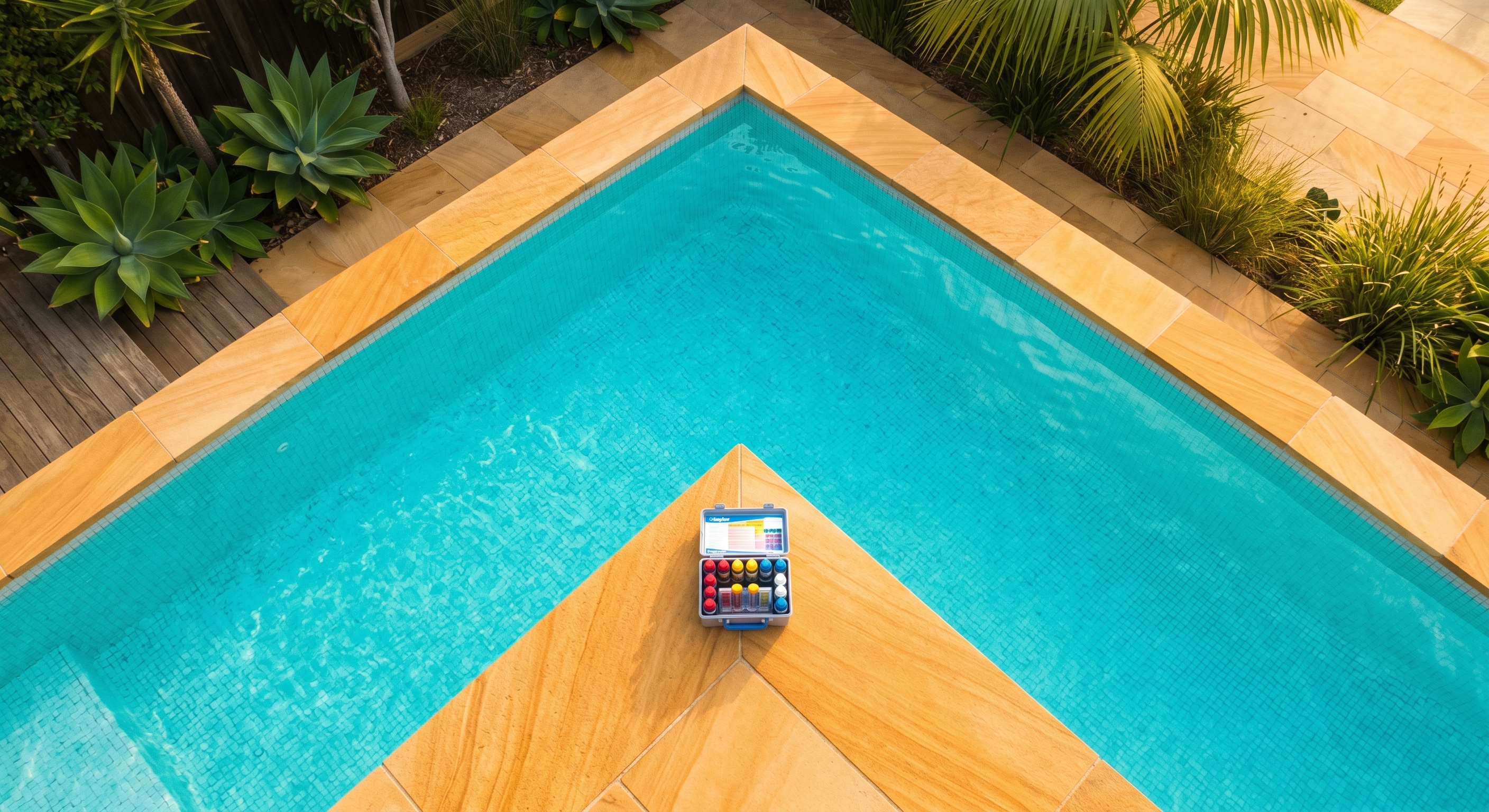
Digital pool water testers - are they worth it?
A digital pool water tester gives you free chlorine, pH, and alkalinity readings in 60 seconds without measuring drops — but no consumer model replaces a drop kit for CYA, and none tell you how much chemical to add next. Photometer-based units like the LaMotte WaterLink Spin and Taylor ColorQ Pro 7 read free chlorine and pH within about 5 percent of a Taylor K-2006, which is genuinely accurate. Floating monitors like the WaterGuru Sense and Sutro automate the test schedule but tie you to a $180 to $250 annual reagent cartridge subscription and skip CYA entirely.
A digital tester is a measurement upgrade, not a chemistry upgrade. The reading is more precise, but a precise reading of the wrong parameter (or no CYA reading at all) still puts you in the same fight with cloudy water. Test first, then dose — and make sure CYA is in the panel.
I have run a Taylor K-2006 alongside a LaMotte Spin Touch and a WaterGuru Sense across three pool seasons. The conclusion below is from that side-by-side, not from product pages. The short version: for free chlorine and pH, digital wins on speed and ties on accuracy. For CYA and calcium hardness, the drop kit still wins. For deciding what to do next, none of them help.
What a Digital Pool Tester Actually Measures
There are three different things sold under the label "digital pool water tester," and they are not the same product.
| Type | How It Works | Examples | Tests Performed |
|---|---|---|---|
| Handheld photometer | Reads light absorbance through a reagent-treated water sample | LaMotte WaterLink Spin Touch, Taylor ColorQ Pro 7 | FC, CC, pH, TA, CYA, CH, copper, iron (model-dependent) |
| Floating IoT monitor | Continuous in-pool device, runs scheduled tests with cartridge reagents | WaterGuru Sense, Sutro | FC, pH, TA (Sutro); FC, pH, TA + CH/CYA add-ons (WaterGuru Sense+) |
| Digital strip reader | Camera or LED reader that interprets a dipped test strip | AquaChek TruTest, Hach Pocket Colorimeter | FC, pH, TA, CYA, CH (depending on strip) |
A photometer is the closest digital equivalent to a drop kit. You take a water sample, add reagent (a tablet, a "spin disk," or dropper liquid), and the device shines a calibrated light through the sample and reads the color change as a number. The math that you would do by counting drops happens inside the device.
A floating IoT monitor is a different design choice — instead of you taking samples, the device sits in your skimmer basket and pulls in water on a schedule, runs the test against an internal reagent cartridge, and pushes the result to your phone. The hardware is more expensive, the per-test cost runs higher, and the parameter list is shorter, but you stop doing the work.
A digital strip reader is a strip with electronics bolted on. The strip is still a strip — the reader just replaces your eyeball matching the color band against the bottle label. Accuracy is bounded by the strip, which means it is bounded at "okay for chlorine and pH, weak on CYA and alkalinity." See the pool test strips guide for the full strip vs reagent comparison.
The Main Digital Testers Compared
I have organized this by what people actually buy in 2026. Prices below are MSRP as of June 2026 and may shift seasonally — check the manufacturer site for current pricing before buying.
| Tester | Type | Tests | Device Cost | Annual Reagent Cost | Notes |
|---|---|---|---|---|---|
| LaMotte WaterLink Spin Touch | Photometer | FC, CC, pH, TA, CYA, CH, copper, iron, salt, phosphate, borate | $700 to $900 | $200 to $300 | Pro-grade; what your pool store likely uses |
| Taylor ColorQ Pro 7 | Photometer | FC, CC, pH, TA, CYA, CH, copper | $300 to $400 | $40 to $60 | Closest digital match to the K-2006 |
| WaterGuru Sense+ | Floating IoT | FC, pH, TA + CYA/CH cartridge add-on | $349 | $180 to $250 (subscription) | Twice-weekly auto-tests, app reporting |
| Sutro Smart Monitor | Floating IoT | FC, pH, TA | $349 | ~$300 (subscription) | Daily auto-tests, no CYA or CH |
| AquaChek TruTest | Digital strip reader | FC, pH, TA | $50 to $80 | Cost of strips ($20/yr) | Cheap, strip-bounded accuracy |
A few things that are not on the spec sheets but matter:
- Subscription dependence. Sutro and WaterGuru both stop working if the reagent cartridge subscription lapses. The device becomes a paperweight without the cartridges. A Taylor K-2006 or ColorQ keeps working if you buy reagents from any supplier.
- CYA gap on continuous monitors. Sutro does not measure CYA. The WaterGuru Sense+ measures it through a separate add-on cartridge, and field reports from pool forums place its accuracy at roughly ±10 to 15 ppm versus a drop kit — wider than the ±5 ppm of a proper turbidity-based CYA test.
- Photometer turbidity sensitivity. Both the LaMotte Spin and Taylor ColorQ can misread on cloudy water — the same algae bloom you are trying to diagnose can throw the CYA and CH readings off. Run those parameters on a clear-water day.
- iPhone or Android requirement. Every floating monitor depends on a phone app and Wi-Fi. If your pool equipment pad does not have signal, the device cannot upload results.
Accuracy by Parameter
The headline number — "lab accuracy at home" — is true for free chlorine and pH but not for CYA or calcium hardness. My side-by-side numbers below are from running the same water sample through a Taylor K-2006, a LaMotte Spin Touch, and a WaterGuru Sense+ over the 2025 season.
| Parameter | Digital Tester Accuracy vs Taylor K-2006 | Notes |
|---|---|---|
| Free chlorine (FC) | Within ±0.3 ppm at FC under 10 ppm | Photometers tie or slightly beat drop kits on low FC; both can read low above 15 ppm |
| pH | Within ±0.1 unit | Effectively a tie with drop kits |
| Combined chlorine (CC) | Within ±0.3 ppm at CC under 1.0 ppm | Less reliable than the FAS-DPD method on a Taylor K-2006 above 1 ppm |
| Total alkalinity (TA) | Within ±10 ppm | Photometer ties; cartridge monitors run slightly high |
| Cyanuric acid (CYA) | ±10 to 20 ppm | The weak spot — turbidity-based reagents do not translate well to optical readers |
| Calcium hardness (CH) | ±25 to 50 ppm | Acceptable but not great; verify monthly with a drop kit |
The pattern is consistent across every digital tester I have used: free chlorine, combined chlorine, pH, and alkalinity translate well to photometric reading because they are color reactions with sharp endpoints. CYA and calcium hardness translate badly because their reagents work by precipitation and titration, which photometers approximate rather than measure directly.
This is why I keep a drop kit even after buying a Spin Touch. The Spin handles weekly testing in three minutes. The K-2006 verifies CYA and CH once a month. For the chemistry behind those targets, the pool water testing guide walks through what each number means and why CYA changes the FC target.
Cost of Ownership Over Five Years
A $349 floating monitor that needs $200 of cartridges per year is not cheaper than a $90 Taylor K-2006 that needs $35 of reagents per year. It is faster, and the time tradeoff is the real question.
| Setup | Year 1 Cost | 5-Year Cost | Time Per Test |
|---|---|---|---|
| Taylor K-2006 only | $90 | $230 | 6 to 8 min |
| Taylor ColorQ Pro 7 + occasional K-2006 | $400 | $640 | 3 to 4 min |
| LaMotte Spin Touch + K-2006 | $890 | $2,030 | 3 min |
| WaterGuru Sense+ + K-2006 (for CYA) | $529 | $1,469 | 0 min (auto) + 2 min/mo |
| Sutro + Taylor K-2006 (for CYA) | $529 | $1,989 | 0 min (auto) + 2 min/mo |
Floating monitors charge an ongoing fee for the convenience of skipping the test. Photometers charge once up front and then run on cheap reagents. For most residential pools, the breakeven question is: is two minutes a day worth $40 a month? If yes, a Sutro or WaterGuru pays for itself. If no, a Taylor ColorQ or just the K-2006 alone is the better buy.
For most residential pools, the question is: is 2 minutes a day of manual testing worth $40/month to automate? A floating monitor (WaterGuru, Sutro) pays for itself if yes. A Taylor K-2006 at $90 is the better buy if no.
Who Should Buy a Digital Tester
There are three pool owners I would recommend a digital tester to, and one I would not.
Buy a photometer (LaMotte Spin or Taylor ColorQ) if: you have trouble reading the color matches on a drop kit (color blindness, low light at your pool deck, aging eyes), you want a digital number to enter into a dosing app, or you run a pool service for 5+ pools and need to test faster.
Buy a floating monitor (WaterGuru, Sutro) if: you travel 2+ weeks at a time and want to know the pool chemistry without walking to it, you have help managing the pool who needs the same data, or you genuinely will skip testing without an automated reminder.
Buy a digital strip reader (AquaChek TruTest) if: you want a budget step up from eyeballing strips and accept the strip's accuracy ceiling. It will not replace a drop kit for dose calculations.
Skip the upgrade if: you test twice a week with a K-2006, your numbers are stable, and the only thing slowing you down is deciding what to add. The bottleneck is not the test — it is the math after the test. A $400 photometer does not fix that problem.
Calibration, Reagent Storage, and Safety
Digital testers introduce two failure modes a drop kit does not have: dead batteries and bad reagent cartridges.
- Follow manufacturer calibration instructions. Most consumer photometers (LaMotte Spin, Taylor ColorQ) self-calibrate against a blank water sample on every test cycle. Floating monitors auto-calibrate when you swap cartridges. There is no scheduled calibration step on these — but if the device asks you to run a blank cycle, do it.
- Store the device in a dry environment. Photometers are not waterproof when the sample chamber is open. Keep the unit in a sealed plastic box in the garage or pool shed, not in a damp pump room.
- Replace reagents annually. Spin disks, ColorQ tablet packs, and Sutro cartridges all degrade after about 12 months even if unopened. Expired reagents read low on chlorine and high on pH, both of which lead to overdosing.
- Never mix pool chemicals together. Photometer reagents are sometimes packaged in proximity to the device. Keep them in their original containers, away from chlorine and acid storage. Acid and chlorine mixed in a closed cabinet release chlorine gas.
- When you do add chemicals after testing, add chemical to water — never water to chemical. Wear chemical-resistant goggles and gloves when handling concentrated reagents from spin packs, dropper bottles, or any acid-based pH reagent. Store all pool chemicals in their original containers, in a cool dry place, with chlorine on one shelf and acid on another.
A Digital Tester Does Not Tell You What to Add
This is the gap none of these devices close. The LaMotte Spin reads 11 parameters and gives you 11 numbers. The Sutro app shows you a green dot when chlorine is in range and a red dot when it is not. Neither tells you that your FC reading of 3 ppm is dangerously low because your CYA is 80 ppm, or that you need to add 14 oz of 12.5% liquid chlorine to a 15,000-gallon pool to raise FC by 2 ppm.
That math is what people get wrong. The CYA-to-FC relationship alone is the largest source of stuck-with-algae problems I see in pool forums, and a digital reading of "FC 3 ppm" looks fine until you compare it to a CYA of 90 ppm and realize the pool needs FC at 7 ppm minimum.
The Poolably app pairs with any testing method — strip, drop kit, photometer, or floating monitor. Enter the six numbers, enter your pool volume, and it tells you what to add and how much. iOS only. If you adjust pH once a month and your other numbers are stable, you can absolutely do this math by hand with a calculator and the chart on a chlorine jug — see the pool chemical calculator guide for the manual version. The app earns its keep when you are testing twice a week and dosing four different chemicals across the season.
The Honest Verdict
Digital pool water testers solve the speed and color-reading problems. They do not solve the CYA accuracy problem on consumer hardware. They do not solve the "what do I add now" problem at all. If your only frustration with pool testing is the six minutes it takes, a Taylor ColorQ Pro 7 at around $350 is the best dollar-per-accuracy ratio on the market. If you want hands-off monitoring and accept a $200+ annual subscription, the WaterGuru Sense+ is the most complete floating monitor because it actually reports CYA. If you want the closest thing to a pool store lab in your garage, the LaMotte Spin Touch is genuinely accurate — but for most pool owners it is overspec'd.
I keep my Taylor K-2006 next to my Spin Touch in the garage. The Spin gets used three times a week for fast checks. The K-2006 comes out monthly for CYA and CH verification, and any time something looks wrong. Both feed numbers into the same dosing math.
Sources
Notes on accuracy ranges are from side-by-side residential testing across the 2025 season on a 16,000-gallon vinyl pool. Subscription pricing and feature lists were checked against manufacturer product pages as of June 2026. Both Sutro and WaterGuru run periodic promotions that change the effective annual cost — check current pricing before committing to a subscription model.
Frequently Asked Questions
Vlad Kuzin
Pool owner and builder of the Poolably app. I got tired of guessing at chemical doses, so I built a calculator that does the math.