Pool Test Strips: How to Read Them and When They Lie
Pool test strips give you a rough estimate of your water chemistry — not the precise reading most pool owners assume they are getting. I have seen strip readings for pH differ from a liquid test kit by 0.4 in side-by-side tests, which is the difference between doing nothing and needing to add acid. Strips are fast and cheap, and they have a place in your testing routine — but only if you understand where they fail and use them correctly.
How to Read Pool Test Strips
The technique matters more than the brand. Every strip manufacturer prints instructions on the bottle, and most pool owners skip at least one step. Here is the process that produces the most reliable reading.
Step by Step: Getting an Accurate Reading
-
Dry your hands completely. Moisture on your fingers contaminates the reagent pads before the strip touches the water. This is the single most common mistake.
-
Pull one strip from the bottle and close the cap immediately. The remaining strips absorb humidity every second the cap is off.
-
Dip the strip elbow-deep in the pool, away from return jets. Surface water and water near jets does not represent your pool's overall chemistry.
-
Hold the strip underwater for 2 seconds, then remove it. Do not swish it around.
-
Hold the strip horizontal. Holding it vertically lets reagent from one pad bleed into the next, contaminating your readings.
-
Wait the exact time printed on your bottle. This is usually 15 seconds for chlorine and pH, 30 seconds for alkalinity and hardness. Reading too early gives artificially low results. Reading too late gives artificially high results as the pads overdevelop. Set a timer on your phone.
-
Compare the pads to the color chart in natural daylight. Indoor lighting — especially LED and fluorescent — shifts colors enough to move your reading by a full increment on the chart.
Read strips in shade, not direct sunlight. Bright sun washes out the color pads and makes it harder to match them to the chart. Natural daylight in a shaded area gives the most accurate color comparison.
Do not touch the colored pads at any point. Oils from your skin react with the reagents and skew the result.
What Each Pad Measures
A standard 5-way test strip covers free chlorine, total chlorine, pH, total alkalinity, and calcium hardness. A 7-way strip adds cyanuric acid (CYA) and total bromine.
Pool Test Strip Chart: Target Ranges
| Parameter | Ideal Range | Low Reading Means | High Reading Means |
|---|---|---|---|
| Free Chlorine | 1–4 ppm | Bacteria and algae can grow | Skin and eye irritation, bleached swimsuits |
| pH | 7.2–7.8 | Corrosion of surfaces and equipment, eye irritation | Scaling, cloudy water, chlorine loses effectiveness — see the pH guide |
| Total Alkalinity | 80–120 ppm | pH swings up and down unpredictably — see the alkalinity guide | pH resists adjustment, scaling on surfaces |
| Cyanuric Acid (CYA) | 30–50 ppm | Sunlight destroys chlorine within hours | Chlorine becomes ineffective at killing bacteria |
| Calcium Hardness | 200–400 ppm | Water dissolves plaster, corrodes metal parts | Scale buildup on tile, in pipes, and on equipment |
These ranges follow Pool & Hot Tub Alliance (PHTA) residential pool guidelines. The CDC Model Aquatic Health Code specifies similar values for public pools, with a stricter CYA maximum of 15 ppm — impractical for most outdoor residential pools where sunlight demands more stabilizer.
If your CYA reads above 50 ppm, your free chlorine target needs to increase. The relationship between CYA and chlorine is the single most important concept in pool chemistry that test strips cannot help you manage.
Why Pool Test Strips Give Wrong Readings
I used test strips exclusively for my first two years of pool ownership. I was adding chemicals based on readings that were wrong by enough to matter, and I could not figure out why my water never balanced. Once I started cross-checking with a liquid kit, I found exactly where strips break down.
Humidity Destroys Strips Before You Use Them
The reagent pads on test strips are dried chemicals on paper. They work by reacting with water. They also react with water vapor in the air. If your strips live in a pool shed, a garage, or anywhere with temperature swings, the pads are slowly activating before they ever touch your pool.
I started storing my strips inside the house, in an air-conditioned room. The readings became noticeably more consistent. If the cap was left off for more than a minute — which happens when you are juggling a skimmer, a hose, and a test strip — assume that batch is compromised.
Reagents degrade faster than you think. Most test strip reagents expire 1 to 2 years after manufacture, but an opened bottle stored in a humid pool shed can go bad within weeks. If your readings seem inconsistent, replace the bottle before troubleshooting anything else.
Timing Errors Shift Every Parameter
The color on each pad changes continuously as the chemical reaction progresses. At 10 seconds, a pad is one shade. At 30 seconds, it is darker. At 60 seconds, it has overdeveloped and reads high.
The correct reading exists in a narrow window. Most brands specify 15 seconds for chlorine and pH, 30 seconds for alkalinity. "About 20 seconds" in your head is usually 35 seconds in reality. A phone timer eliminates this error.
Color Matching Is Subjective
Two people looking at the same strip will disagree on whether the pH pad matches 7.2 or 7.6 on the chart. This is not carelessness — it is human color perception. The increments on strip charts are genuinely difficult to distinguish, and roughly 8% of men have a degree of color vision deficiency that makes it harder (National Eye Institute).
Lighting compounds the problem. The same strip looks different in afternoon shade, direct sunlight, and under a fluorescent garage light. Always read strips outdoors in natural light, in shade if possible.
Strips Are Nearly Useless for CYA
Even 7-way strips that include a CYA pad give readings I have found unreliable by 20 ppm or more in either direction, compared against a liquid turbidity test. Cyanuric acid is difficult to measure with color-change chemistry. The standard method uses turbidity instead — you look down a tube of mixed water and reagent until a dot disappears.
This matters because CYA controls how effective your chlorine is. A strip that shows CYA at 40 ppm when it is actually 70 ppm means your free chlorine target is wrong, your water is under-sanitized, and you are one warm week away from algae. If your pool has already turned green, the SLAM (Shock Level and Maintain) method requires an accurate CYA number to set the right chlorine target. Strips will not give you that.
Chlorine Bleachout: The Most Dangerous Strip Error
At very high chlorine levels — above roughly 10 ppm — the DPD reagent on a test strip can bleach out. The pad turns pale or clear instead of dark purple, making it look like chlorine is near zero when it is actually very high. Basic liquid DPD kits have this same problem.
This is a safety issue. If you are shocking your pool and the strip shows zero chlorine, you might add more — potentially raising chlorine to dangerous levels. An FAS-DPD kit (like the Taylor K-2006) avoids bleachout entirely because it uses a drop-count titration. You add drops until a color change occurs, so there is no ambiguous color to misread.
Pool Test Strips versus Liquid Test Kits
| Test Strips | Basic Liquid Kit (DPD) | FAS-DPD Kit (Taylor K-2006) | |
|---|---|---|---|
| Cost | $8–15 for 50–100 strips | $15–30 | $70–90 |
| Time per test | 30 seconds | 3–5 minutes | 5–10 minutes |
| Chlorine precision | Low — color matching in broad increments | Moderate — color comparison with finer gradations | High — each drop equals a precise ppm value |
| pH precision | ~0.4 increments; easy to misread | ~0.2 increments | ~0.2 increments |
| CYA measurement | 7-way strips only; unreliable | Usually not included | Yes — turbidity test included |
| Chlorine bleachout | Yes — false zero at high chlorine | Yes | No — works at any chlorine level |
| Shelf life | 1–2 years sealed; degrades fast once opened | Reagents last about 1 year after opening | Reagents last about 1 year after opening |
| Best for | Weekly routine checks when pool looks fine | Budget-friendly routine testing | Troubleshooting, SLAM, precise dosing |
The Taylor K-2006 costs more upfront, but reagent refills run $30–50 per year. Over a full season, the cost per test is comparable to strips — and the accuracy is not.
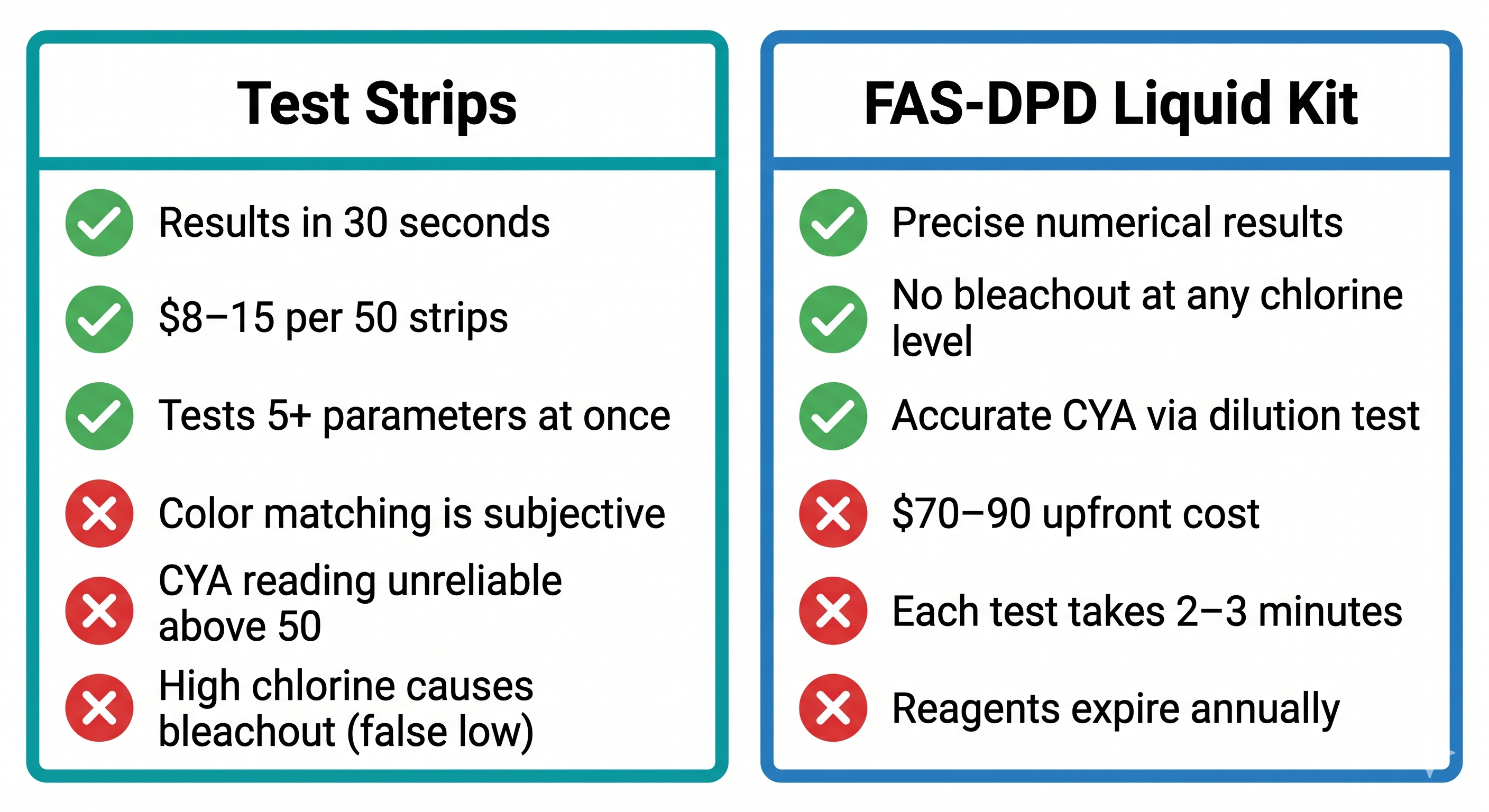
The biggest accuracy gap is chlorine at high levels. Test strips use DPD chemistry that bleaches out above roughly 10 ppm, showing a false zero. A digital pool water tester reads photometrically and avoids the bleach-out problem, and an FAS-DPD liquid kit uses drop-count titration that works at any chlorine concentration — critical during shock treatments when accurate FC readings determine whether you add more chlorine or stop.
When Strips Are Good Enough
Strips are not worthless. For the right situations, they are the right tool.
Use strips when:
- You are checking chlorine and pH as part of a weekly routine
- Your pool looks clear, the water feels normal, and you are confirming nothing has drifted
- You want a 30-second check before a swim
Switch to a liquid kit when:
- Your pool is cloudy, green, or has any visible problem
- You need to measure CYA — at seasonal startup, after adding stabilizer, or when chlorine seems ineffective despite adequate levels on the strip
- Strip readings do not match what you see (the strip says chlorine is fine, but the water looks hazy)
- You are performing a SLAM treatment and need to hold a precise chlorine target
- You are about to add a large amount of any chemical and want to calculate an exact dose — a pool chemical calculator is only as good as the test results you feed it
If you test once a week and only adjust chlorine or pH, the math is straightforward enough to do by hand. But if you are logging results over time, the Pool app for iOS tracks trends across multiple tests, catching slow drift in alkalinity or calcium that a single strip reading would miss. One reading is a snapshot. A trend line tells you where your water is heading.
How to Store Test Strips
- Keep the bottle in an air-conditioned room — not the pool shed, not the garage
- Close the cap tightly after every use, within seconds
- Do not store strips in direct sunlight or near any heat source
- Never transfer strips to a different container (the original bottle includes a desiccant)
- Check the expiration date when you buy and again at the start of each pool season
- In humid climates — Florida, the Gulf Coast, the Southeast — buy smaller bottles and replace them more frequently rather than stocking up
Chemical Safety After Testing
Once your test results tell you what to add, handle pool chemicals carefully.
Test first, always. Never add chemicals on a schedule or a guess. Your test results determine the dose.
Never mix different pool chemicals together. Chlorine products and muriatic acid produce toxic chlorine gas when combined. This applies to mixing in a bucket, storing containers next to each other, and adding one chemical to the pool before the previous one has fully dispersed.
Add chemical to water, not water to chemical. When dissolving granular chemicals like calcium hypochlorite or pH increaser in a bucket, fill the bucket with pool water first, then add the chemical slowly.
Wear chemical-resistant goggles and gloves when handling any pool chemical. Muriatic acid, calcium hypochlorite, and sodium hydroxide cause burns on contact with skin and eyes.
Store chemicals in their original containers, in a cool dry place, with oxidizers (chlorine products) and acids (muriatic acid) separated from each other.
Frequently Asked Questions
How do I read pool test strips?
Dip the strip elbow-deep in pool water for 2 seconds with dry hands, remove it, and hold it horizontally. Wait the time specified on your bottle — usually 15 to 30 seconds — then compare each color pad to the chart in natural daylight. Do not shake off excess water or touch the pads with your fingers.
How accurate are pool test strips?
Test strips provide approximate readings adequate for routine weekly checks of chlorine and pH. For total alkalinity, calcium hardness, and especially cyanuric acid, strips can be off by enough to change what chemicals you add and how much. A liquid reagent kit like the Taylor K-2006 gives more precise results when you are troubleshooting a problem or calculating exact chemical doses.
Do pool test strips expire?
Yes. Most strips expire 1 to 2 years after manufacture. Expired strips give unreliable readings because the reagent chemicals on each pad break down over time. Humidity and heat accelerate this degradation, so a bottle stored in a hot pool shed may produce bad readings well before its printed expiration date.
Can pool test strips measure stabilizer (CYA)?
Basic 5-way and 6-way strips do not measure cyanuric acid. Most 7-way strips include a CYA pad, but it is one of the least accurate measurements on any strip. For a reliable CYA reading, use a liquid turbidity test — the kind included in the Taylor K-2006 kit — where you look down a tube until a black dot disappears.
What should my pool test strip readings be?
For a residential pool: free chlorine 1 to 4 ppm, pH 7.2 to 7.8, total alkalinity 80 to 120 ppm, cyanuric acid 30 to 50 ppm, and calcium hardness 200 to 400 ppm. These ranges follow Pool & Hot Tub Alliance (PHTA) guidelines. If your CYA is above 50 ppm, you need a higher free chlorine level to maintain the same sanitizing power.
Why do my pool test strips give different readings each time?
Inconsistent readings typically come from three causes: the strips were exposed to humidity (left uncapped or stored in a damp location), your hands were wet when you pulled a strip from the bottle, or you are reading the color at different times after dipping. Store strips in a cool, dry indoor space, always use dry hands, and set a phone timer for the exact wait time specified on your bottle.
Frequently Asked Questions
Vlad Kuzin
Founder of Poolably. Building the most practical pool chemistry calculator on iOS.