CYA and Chlorine: Why Your Pool Store Gets It Wrong
You test your pool. Free chlorine reads 3 ppm. The pool store says you are in range. Two days later, your pool is green. What happened?
The answer is almost always cyanuric acid. CYA is the most misunderstood chemical in pool care, and the generic "maintain chlorine at 1–3 ppm" advice that appears on every test strip bottle and pool store printout ignores it completely. That advice is not just incomplete — it is actively misleading for any pool with CYA in the water.
What Cyanuric Acid Does
CYA acts as a UV shield for chlorine. Sunlight (specifically UV-A and UV-B radiation) breaks down hypochlorous acid — the active form of chlorine — very rapidly. In an unstabilized outdoor pool, you can lose 75–90% of your free chlorine in just 2–3 hours of direct sun.
CYA bonds with free chlorine molecules, forming chlorinated isocyanurates. These compounds are much more resistant to UV degradation. The CYA-chlorine bond is reversible — as active chlorine is consumed (killing bacteria, oxidizing contaminants), more chlorine is released from the CYA reservoir. This interaction also depends on pH balance — higher pH further reduces the active chlorine fraction on top of the CYA effect.
This is genuinely useful. Without CYA, maintaining an outdoor pool would require adding chlorine multiple times per day. CYA makes outdoor pool maintenance practical.
The Problem: CYA Also Reduces Chlorine's Killing Power
Here is the part that most pool owners — and most pool professionals — do not understand. CYA does not just protect chlorine from the sun. It also reduces the amount of chlorine that is immediately available to kill pathogens and algae.
At any given moment, only a small percentage of your free chlorine is in the active form (hypochlorous acid). The rest is bound to CYA in a temporary reservoir. The higher your CYA, the smaller the percentage of FC that is active.
The numbers are dramatic:
| CYA (ppm) | % of FC That Is Active |
|---|---|
| 0 | 100% (at pH 7.5, ~50% HOCl) |
| 20 | ~4% |
| 40 | ~2.5% |
| 60 | ~1.6% |
| 80 | ~1.2% |
| 100 | ~1% |
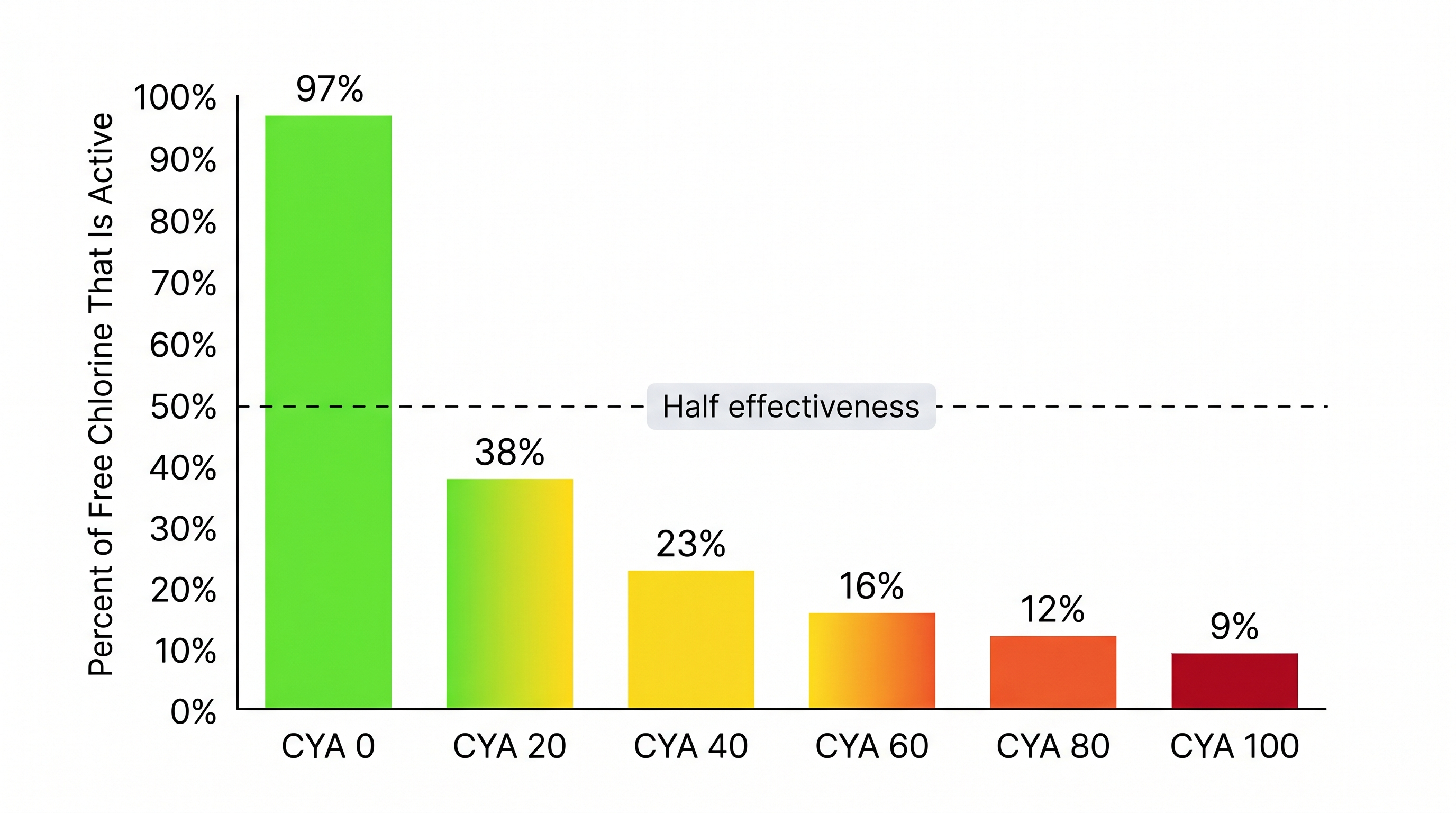
At CYA 0, with FC of 3 ppm and pH 7.5, you have about 1.5 ppm of active hypochlorous acid. At CYA 80, with the same FC of 3 ppm, you have about 0.036 ppm of active HOCl. That is roughly 40 times less killing power — with the same FC reading on your test kit.
The "1–3 ppm" chlorine recommendation is dangerously wrong for stabilized pools. Your test kit shows FC of 3, but in a pool with CYA of 80, the effective sanitation is 40x less than what you need. Always set your FC target based on your CYA level.
The CYA-FC Ratio
The pool chemistry community has established that the minimum effective FC level is approximately 7.5% of CYA, with a practical minimum of 2 ppm. Your daily target should be somewhat above this minimum to provide a safety margin.
Here are the minimum FC targets by CYA level:
| CYA (ppm) | Min FC (ppm) | Recommended Target FC (ppm) | Shock Level FC (ppm) |
|---|---|---|---|
| 0 | 2 | 2–4 | 10 |
| 20 | 2 | 2–4 | 10 |
| 30 | 2 | 2–5 | 12 |
| 40 | 3 | 3–6 | 16 |
| 50 | 4 | 4–7 | 20 |
| 60 | 5 | 5–8 | 24 |
| 70 | 5 | 5–8 | 28 |
| 80 | 6 | 6–9 | 31 |
| 90 | 7 | 7–10 | 35 |
| 100 | 8 | 8–11 | 39 |
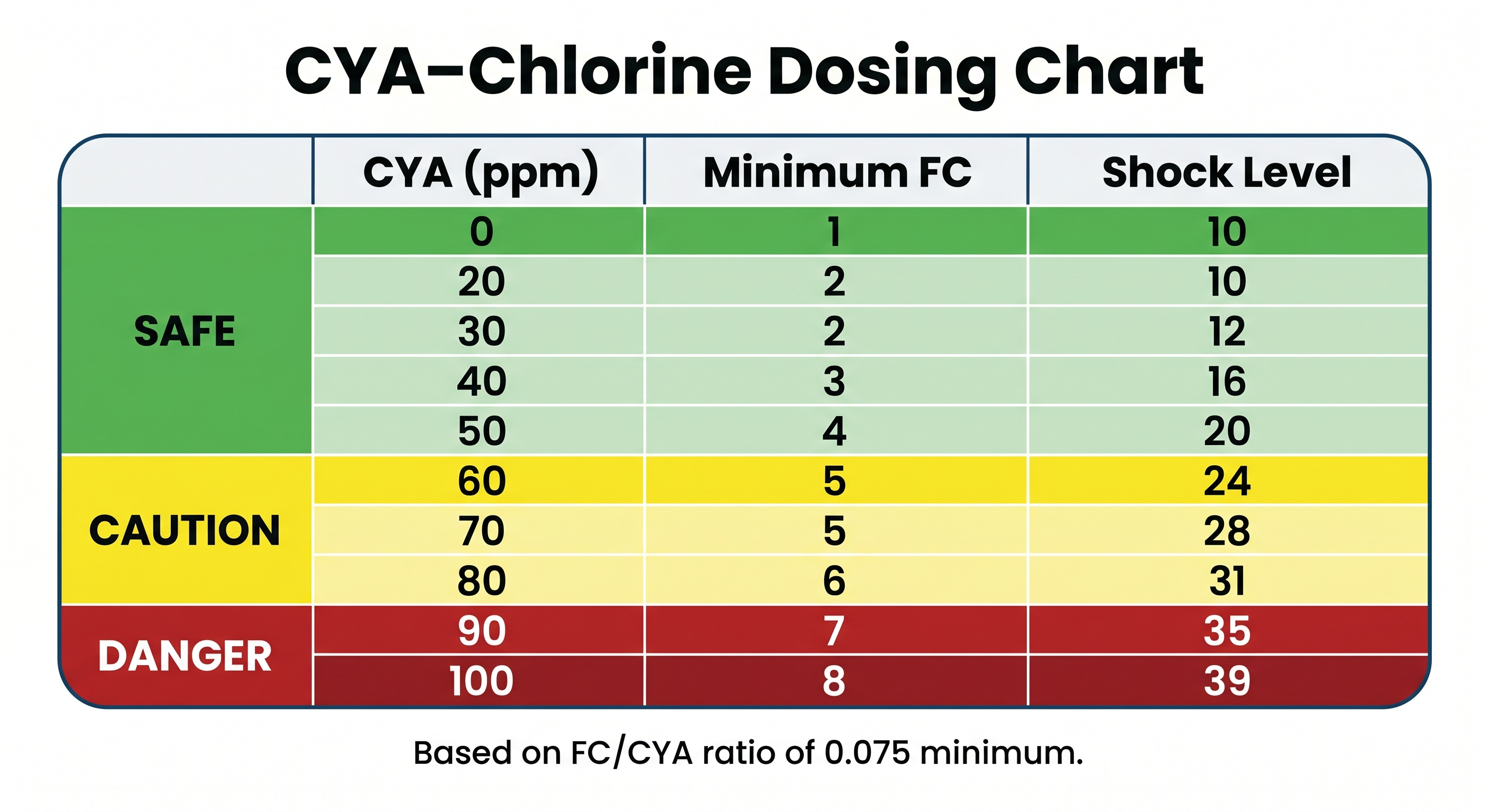
Shock level is the FC needed to kill established algae (the SLAM process). Notice how dramatically shock level increases with CYA. At CYA 100, you need 39 ppm of FC to shock — an enormous amount of chlorine. This is why preventing high CYA is far easier than treating its consequences.
Why Pool Stores Get It Wrong
Three compounding factors:
1. They sell trichlor tablets
Trichlor (trichloroisocyanuric acid) is the most common form of pool chlorine — those 3-inch pucks in the floating dispenser or inline feeder. They are convenient, stable, and effective at delivering chlorine slowly.
But trichlor is approximately 54% available chlorine and 46% CYA by weight. Every puck raises your CYA. A typical residential pool using 2–3 trichlor pucks per week will see CYA rise by roughly 5–10 ppm per month during swim season. By midsummer, CYA is commonly 80–120+ ppm.
Pool stores sell a lot of trichlor. Telling customers that their primary chlorine source is the reason their pool has problems is not great for sales.
2. Their test equipment ignores the relationship
Most pool store water testing machines test free chlorine and CYA as separate, independent parameters. The printout shows "FC: 3 ppm — IN RANGE" and "CYA: 90 ppm — SLIGHTLY HIGH" as if these are unrelated facts. They never cross-reference the two to tell you that FC of 3 at CYA 90 is effectively no sanitation.
3. Generic ranges are easier to communicate
"Keep chlorine at 1–3 ppm" fits on a test strip bottle. "Keep chlorine at 7.5% of your CYA level, minimum 2 ppm, and if CYA is above 80 you should drain and refill" does not. The simplified message persists because it is simple, even though it is wrong for most real-world pools.
What Happens When CYA Gets Too High
When CYA climbs above 80–100 ppm, four problems compound:
Algae growth despite "normal" chlorine. Your FC reads 3 ppm but effective sanitizer is near zero. Green algae gains a foothold, then blooms.
Chlorine demand becomes impractical. At CYA 100, your minimum FC target is 8 ppm. That is a lot of chlorine to maintain daily, and shocking requires FC of 39 ppm — roughly 3 gallons of liquid chlorine per 10,000 gallons of pool water.
Impossible to clear algae. If you develop an algae bloom at CYA 150+, the shock level is so high that it is impractical to treat. At that point, a partial drain is the only realistic option.
Salt cell scaling (SWG pools). Salt chlorine generators produce chlorine at a fixed rate. When CYA is very high, the SWG cannot produce enough chlorine to maintain the minimum FC level, no matter the output percentage.
How to Lower CYA
There is only one reliable method: dilution.
Partial drain and refill. Drain a calculated percentage of your pool water and refill with fresh water. The math is straightforward:
- Current CYA: 100 ppm
- Target CYA: 50 ppm
- Percentage to drain: (100 - 50) / 100 = 50%
Drain half the pool, refill, then retest after the water has circulated. In practice, do this in stages — drain 25–30%, refill, retest, and repeat if necessary.
Never fully drain a pool without professional guidance. Groundwater pressure can pop a fiberglass or vinyl pool out of the ground, and plaster pools can crack. Drain in stages — 25-30% at a time — and refill between each.
Important considerations:
- Check local regulations on pool water discharge. In most jurisdictions, you must neutralize chlorine before draining to storm drains.
- After refilling, rebalance all chemistry — dilution lowers everything, not just CYA. Pay particular attention to alkalinity, which affects pH stability and needs to be restored to 80–120 ppm after any significant water replacement.
What about CYA reducer products? A few products claim to reduce CYA biologically (using specialized bacteria). Results are inconsistent, slow (4–6 weeks), and the products typically cost $50–80 per treatment. Partial drain is faster, cheaper, and reliable.
Preventing High CYA
The best strategy is to stop CYA from climbing in the first place.
Switch to liquid chlorine for daily sanitization
Liquid chlorine (sodium hypochlorite, 10–12.5%) and regular bleach (sodium hypochlorite, 6–8.25%) add zero CYA. Use liquid chlorine as your primary sanitizer and add CYA separately (as dry stabilizer) only when needed.
Use trichlor strategically, not exclusively
Trichlor tablets are convenient for vacation periods or as a supplement, but they should not be your only chlorine source. If you use trichlor, monitor CYA monthly and switch to liquid chlorine when CYA reaches your target (30–50 ppm for most pools, 60–80 for saltwater pools).
Test CYA regularly
CYA does not degrade, evaporate, or get filtered out. It only leaves your pool through splash-out, backwash, and drain. If you are not adding trichlor or dichlor, CYA stays essentially constant. Test monthly during season to track the trend.
CYA only leaves your pool through water removal. Unlike chlorine, CYA does not break down from sunlight, heat, or chemical reactions. The only way to reduce it is to physically remove water and replace it with fresh water.
CYA for Saltwater Pools
Salt chlorine generators produce chlorine continuously, which partially compensates for high CYA by maintaining a steady FC level. Saltwater pools can run CYA at 60–80 ppm comfortably because the SWG replenishes chlorine constantly throughout the day.
However, this does not mean CYA does not matter for saltwater pools. If CYA exceeds 80–100, even the SWG at 100% output may not keep up, especially in hot climates with high bather loads. The same principles apply — you just have a higher practical ceiling before problems start.
Poolably and CYA-Aware Targets
This is exactly the problem Poolably was built to solve. When you enter your test results, Poolably uses your actual CYA reading to calculate your FC target — not a generic range. If your CYA is 80, Poolably tells you that your FC should be 6–9 ppm, not "1–3 ppm."
The treatment plan generator also sequences chemical additions correctly. If your FC is below the CYA-adjusted target, that goes first. If CYA is too high, Poolably recommends a partial drain with the exact percentage to reach your target.
Summary
CYA is essential for outdoor pools — it protects chlorine from sunlight and makes maintenance practical. But CYA also reduces chlorine effectiveness, and the higher it goes, the more chlorine you need. The generic "1–3 ppm" chlorine recommendation ignores this entirely.
Know your CYA. Set your FC target based on your CYA level. And if CYA has climbed too high, drain and dilute — there is no chemical shortcut. For a deeper look at all five key water parameters and how they interact, see the pool chemical calculator guide.
Frequently Asked Questions
Vlad Kuzin
Founder of Poolably. Building the most practical pool chemistry calculator on iOS.