Saltwater Pool Guide: How Much Salt, SWG Maintenance, and Common Myths
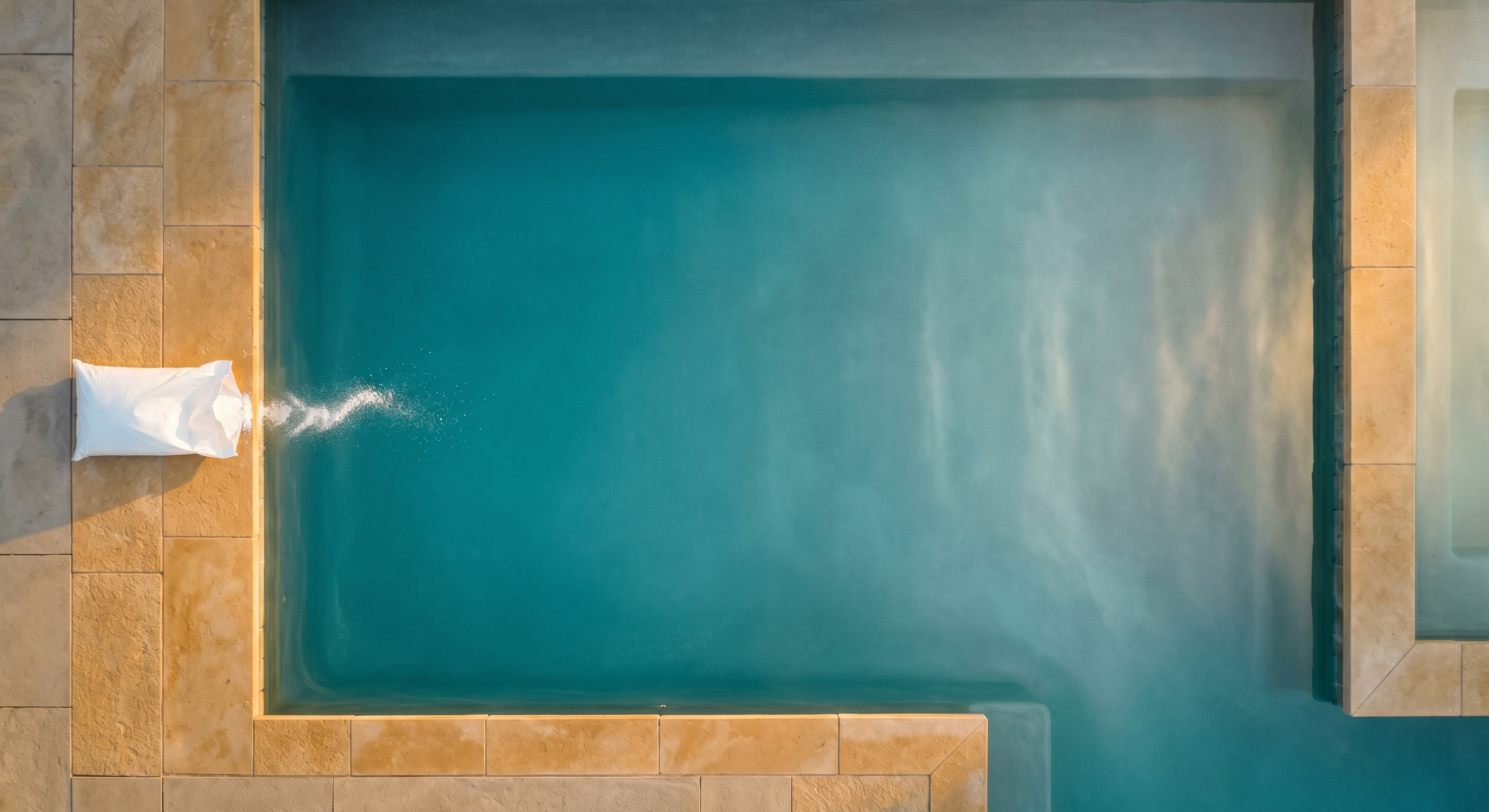
Saltwater pools are the fastest-growing segment in residential pool care. They produce chlorine automatically, reduce the need for liquid chlorine handling, and most owners report that the water "feels softer." But saltwater pools are not maintenance-free — they have their own chemistry considerations, equipment needs, and common pitfalls.
This guide covers everything you need to know about saltwater pool care: how the system works, how much salt to add, how to maintain the salt chlorine generator, and the myths that lead to problems.
How a Salt Chlorine Generator Works
A salt chlorine generator (SWG) converts dissolved salt into chlorine through electrolysis. Here is the process:
- You dissolve pool-grade salt (sodium chloride, NaCl) in the pool water to approximately 3,200 ppm.
- Pool water flows through the SWG cell — a housing containing titanium plates coated with precious metals (ruthenium and iridium).
- When the cell is powered, an electrical current passes through the saltwater between the plates.
- Electrolysis breaks the NaCl and water molecules apart, producing hypochlorous acid (HOCl) — the same active chlorine that liquid chlorine provides.
- The hypochlorous acid sanitizes the water. As it does its work, it recombines back into salt, and the cycle repeats.
This is why salt levels remain relatively stable — salt is not "used up" by the chlorine generation process. Salt is lost slowly through splash-out, backwashing, and dilution from rain.
A saltwater pool is a chlorine pool. The SWG is simply a chlorine delivery method. The water chemistry requirements (FC, pH, TA, CH, CYA) are the same as any chlorine pool. The only additional parameter is salt level.
Ideal Salt Level
Most SWGs are designed for a target salt level of 3,200 ppm with an operating range of 2,700–3,400 ppm. Check your specific unit's manual — targets vary by manufacturer:
- Pentair IntelliChlor: 3,400 ppm target
- Hayward AquaRite: 3,200 ppm target
- Jandy AquaPure: 3,000–3,500 ppm range
- CircuPool: 3,200 ppm target
If salt drops below the minimum (typically 2,500–2,700 ppm), most SWGs display a "low salt" warning and reduce or stop chlorine production. If salt exceeds the maximum (typically 4,000–4,500 ppm), the unit may lock out to protect the cell.
For reference, ocean water is about 35,000 ppm salt. At 3,200 ppm, pool water is about one-tenth as salty as the ocean — most people cannot taste it.
How Much Salt to Add
The formula for calculating salt addition:
Pounds of salt = (target ppm - current ppm) x pool volume in gallons / 1,000,000 x 8.35
The 8.35 factor converts gallons to pounds of water per ppm.
Here is a quick reference table for common pool sizes (raising salt from 0 to 3,200 ppm):
| Pool Volume (gal) | Salt Needed (lbs) | 40-lb Bags |
|---|---|---|
| 10,000 | 267 | 7 |
| 15,000 | 400 | 10 |
| 20,000 | 534 | 14 |
| 25,000 | 667 | 17 |
| 30,000 | 801 | 20 |
For salt level adjustments (your pool already has existing salt), subtract your current reading from the target. For example, a 20,000-gallon pool at 2,800 ppm that needs 3,200 ppm:
(3,200 - 2,800) x 20,000 / 1,000,000 x 8.35 = 66.8 pounds = about 2 bags of 40-lb pool salt.
How to add salt
- Test your current salt level with a salt-specific test strip or drop kit. The SWG's built-in salt reading is an estimate and can be off by 200–400 ppm.
- Calculate the amount needed using the formula above, or use Poolably's dosing calculator.
- Spread the salt across the pool surface, concentrating on the deep end. Do not pour it in one spot — undissolved piles of salt can stain plaster surfaces.
- Run the pump for 24 hours to fully dissolve and distribute the salt. Do not turn on the SWG until the salt is fully dissolved.
- Retest salt level after 24 hours. Add more if needed. It is better to add incrementally than to overshoot.
Add 75–80% of the calculated salt first. Let it dissolve for 24 hours, retest, and fine-tune. Salt is easy to add and very difficult to remove — dilution (draining and refilling) is the only method.
Saltwater Pool Chemistry Targets
Saltwater pools have the same water chemistry targets as traditional chlorine pools, with a few adjustments:
| Parameter | SWG Pool Target | Notes |
|---|---|---|
| Free Chlorine | Based on CYA (same table) | SWG generates continuously; adjust output % to maintain |
| pH | 7.4–7.6 | SWG operation naturally raises pH; expect to add acid regularly |
| Total Alkalinity | 60–80 ppm | Lower than traditional pools to slow pH rise from SWG aeration |
| Calcium Hardness | 200–400 ppm | Keep moderate; high CH + high pH = scale on the salt cell |
| CYA | 60–80 ppm | Higher than traditional pools; SWG compensates with continuous chlorine |
| Salt | 3,200 ppm | Per manufacturer spec |
Why pH rises in saltwater pools
The electrolysis process in the SWG cell generates hydrogen gas as a byproduct. This has the same effect as aeration — it drives off CO2 and raises pH. Saltwater pool owners add muriatic acid more frequently than traditional pool owners. This is normal.
Keeping TA at the lower end of the range (60–80 ppm) slows this pH rise. Higher TA amplifies the buffering effect and makes pH climb faster.
CYA for saltwater pools
Saltwater pools benefit from higher CYA (60–80 ppm) because the SWG produces chlorine continuously throughout the day. The constant replenishment partially compensates for the reduced chlorine effectiveness at higher CYA. However, CYA above 80–100 ppm still causes problems — the SWG at 100% output may not produce enough chlorine to maintain the elevated FC target.
Monitor CYA monthly. If it creeps above 80 and you are not using trichlor (which you should not be, since you have an SWG), the rise is likely from dichlor shock or CYA in your fill water. Partial drain to bring it down.
Salt Cell Maintenance
Salt cells cost $300–$800 to replace. The cell is the most expensive consumable on your equipment pad, lasting 3–7 years with proper maintenance. Quarterly inspections and timely acid cleaning significantly extend cell life.
Inspection schedule
Check the cell every 3 months (quarterly). Remove it from the plumbing union, look through the housing, and check for white calcium scale on the plates.
Cleaning procedure
If you see scale:
- Mix a 4:1 solution of water to muriatic acid in a bucket or the cell cleaning stand. Always add acid to water, never water to acid.
- Submerge the cell plates in the solution for 5–10 minutes. You will see bubbling as the acid dissolves the calcium.
- Do not soak for more than 15 minutes — prolonged acid exposure damages the precious metal coating on the plates.
- Rinse thoroughly with a garden hose.
- Inspect. If significant scale remains, repeat with a fresh solution.
- Reinstall.
Some modern SWGs have reverse-polarity self-cleaning that automatically switches the electrical polarity to shed scale. This reduces cleaning frequency but does not eliminate it entirely. Still inspect quarterly.
Cell lifespan
Most salt cells last 3–7 years or approximately 10,000 operational hours. Output gradually decreases as the coating wears. Signs of end-of-life:
- Chlorine output is insufficient even at 100% with correct salt level
- The cell reports errors or low salt even when salt is correct
- Scale builds up faster than it used to (damaged plates scale more aggressively)
When the cell needs replacement, replace it promptly. Running a dead cell wastes electricity and produces no chlorine — you end up supplementing with liquid chlorine anyway.
Common Saltwater Pool Myths
Myth: Saltwater pools are chlorine-free
Reality: Saltwater pools produce and contain chlorine. The SWG converts salt into hypochlorous acid — the exact same active chlorine found in any chlorinated pool. Pool owners frequently report less eye and skin irritation in saltwater pools, which is likely due to more stable, consistent chlorine levels (the SWG generates continuously rather than in periodic doses) and the absence of chloramines that build up from infrequent shocking.
Myth: Saltwater pools are maintenance-free
Reality: Saltwater pools require the same water testing and balancing as any pool, plus salt cell maintenance. The pH management is actually more demanding because the SWG constantly drives pH upward. You trade the task of adding liquid chlorine for the task of adding muriatic acid.
Myth: Salt damages pool equipment and surfaces
Reality: At 3,200 ppm, salt concentration is very low and does not damage equipment in normal conditions. However, there are two legitimate concerns:
- Galvanic corrosion can occur when dissimilar metals are in contact in saltwater (e.g., a copper heater heat exchanger and stainless steel fittings). A sacrificial zinc anode installed in the plumbing prevents this. Most SWG installations include one.
- Natural stone coping can be damaged by salt splash-out. Saltwater that splashes onto unsealed limestone, travertine, or sandstone coping will deposit salt crystals as it evaporates, which can cause spalling over time. Seal natural stone regularly.
Myth: You never need to add chlorine to a saltwater pool
Reality: When you need to shock (after an algae bloom, heavy bather load, or contamination event), the SWG cannot produce chlorine fast enough. You need to supplement with liquid chlorine to reach shock level quickly. The SWG is designed for daily maintenance chlorination, not emergency shocking.
Myth: Higher salt levels mean more chlorine
Reality: Salt level and chlorine production are not linearly related. The SWG operates optimally within its designed salt range. Adding extra salt above the recommended level does not produce significantly more chlorine and may trigger overvolt protection on the cell. Chlorine output is controlled by the unit's output percentage setting, not the salt concentration.
Saltwater Pool Setup for New SWG Installations
If you are converting a traditional chlorine pool to saltwater:
- Size the SWG correctly. Choose a cell rated for at least 1.5x your pool volume. A 40,000-gallon-rated cell on a 20,000-gallon pool runs at 50% output instead of 100%, which dramatically extends cell life.
- Install a sacrificial zinc anode in the plumbing to prevent galvanic corrosion.
- Add salt gradually. Add 75% of the calculated amount, dissolve for 24 hours, retest, then top off. Do not turn on the SWG until salt is fully dissolved and within range.
- Set CYA to 60–80 ppm. Add dry stabilizer in a sock in the skimmer if CYA is low.
- Lower TA to 60–80 ppm. Use muriatic acid to lower TA, then aerate to bring pH back up without raising TA. This may take 2–4 cycles.
- Start with a low SWG output percentage (30–40%) and increase as needed based on FC readings. Check FC daily for the first week to find the right output setting.
Seasonal Adjustments
Salt chlorine generators need adjustment as conditions change:
Summer (high demand):
- Increase SWG output to 60–80% or higher
- Test FC more frequently (3x/week)
- Expect to add acid weekly for pH control
- Inspect salt cell mid-season
Winter (low demand, warm climates):
- Reduce SWG output to 20–40%
- Most units have a "winter mode" that reduces runtime
- Test FC weekly
- Clean the salt cell before winter if it is due
Winterization (freeze climates):
- Remove the salt cell before closing your pool. Salt cells are expensive and fragile. A cell full of water that freezes can crack the housing.
- Rinse and inspect. Clean if needed.
- Store indoors in a dry location.
- Reinstall in spring after the system is primed and running.
Poolably and Saltwater Pools
Poolably supports saltwater pools natively. When you set up a pool profile with an SWG, the app:
- Adjusts CYA targets to 60–80 ppm
- Sets TA targets to 60–80 ppm
- Includes salt level tracking and dosing calculations
- Calculates the exact pounds of salt to add based on your current reading, target, and pool volume
- Generates treatment plans that account for the SWG's continuous chlorine production
Enter your salt level with each test and Poolably tracks the trend, alerting you when salt drops below your SWG's minimum.
Frequently Asked Questions
Vlad Kuzin
Founder of Poolably. Building the most practical pool chemistry calculator on iOS.