Pool Algae: How to Kill Green, Yellow, and Black Algae
Pool algae comes in three forms — green, yellow, and black — and killing each one requires a different combination of brushing and chlorine shock targeted to your CYA level. A bottle of algaecide poured over black algae will accomplish nothing because the chemical cannot penetrate the algae's protective outer layer. Effective algae treatment starts with identifying the type, then shocking at the right chlorine concentration and maintaining that level for days, not hours.
The Three Types of Pool Algae
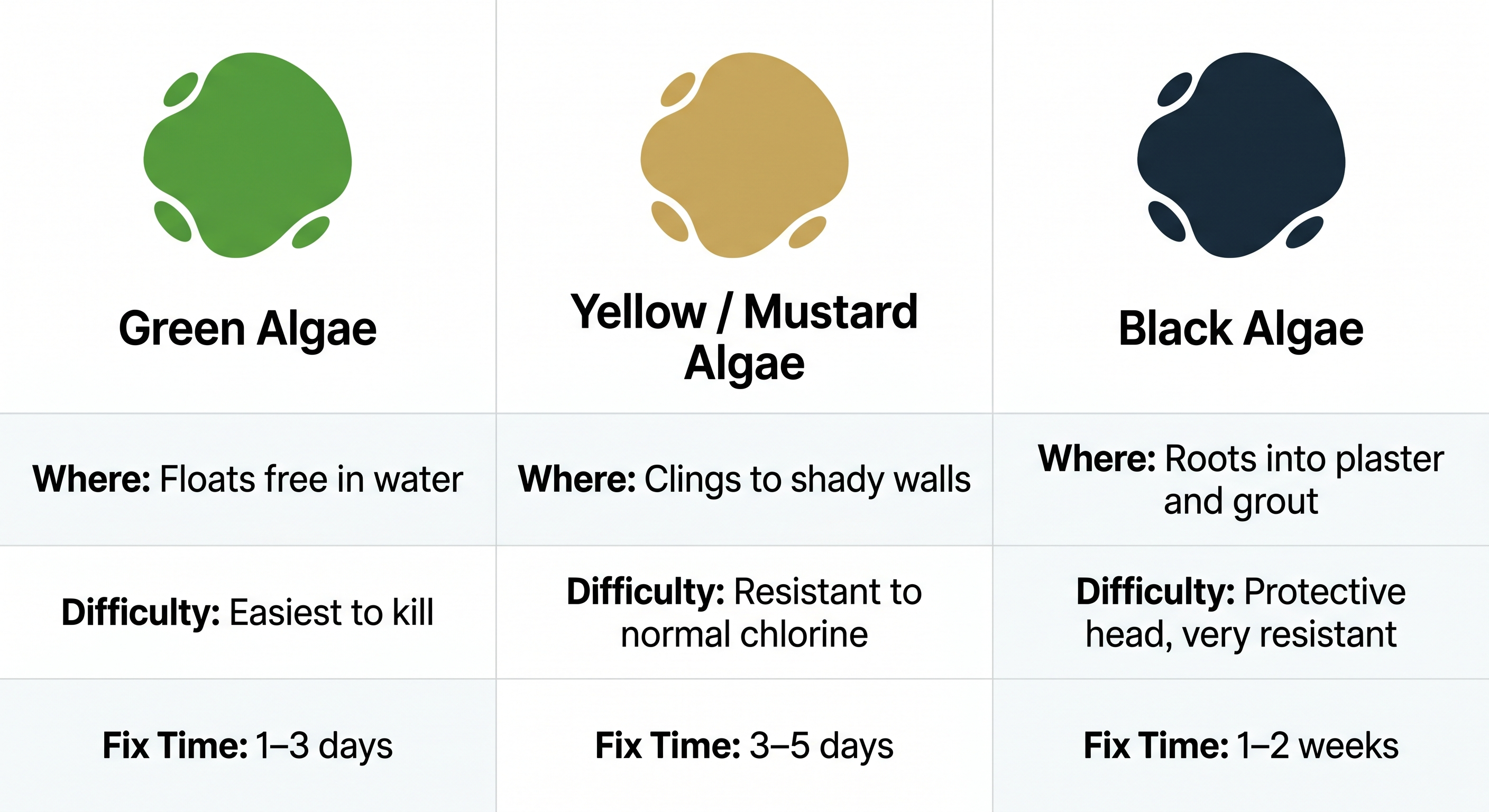
The type of algae in your pool determines the treatment intensity. Green algae and black algae are not the same organism, and a shock dose that kills one will barely affect the other.
Green Algae
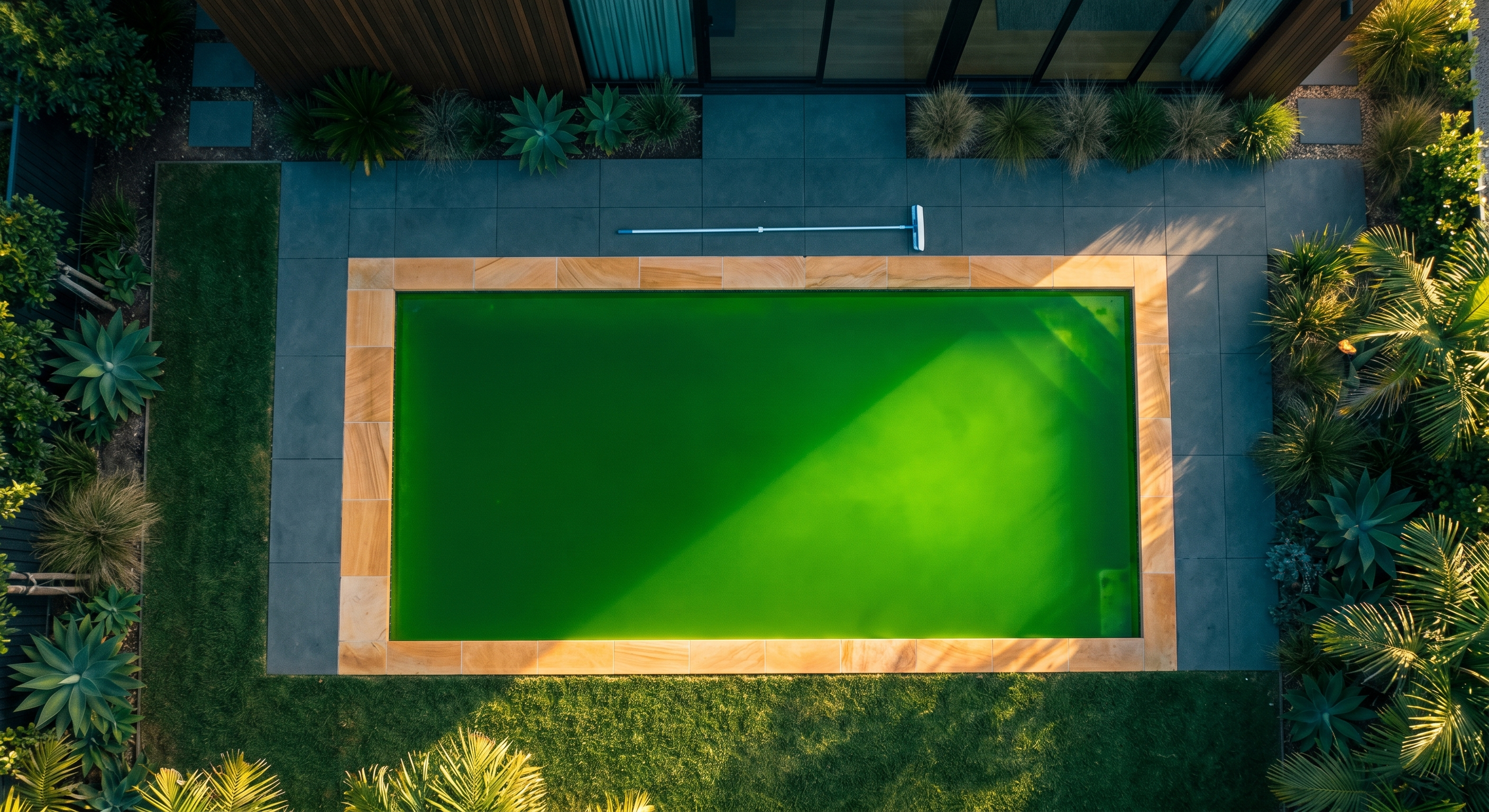
Green algae is the most common type. It floats freely in the water column, turning your pool hazy green in a mild case or opaque swamp green in a severe one. A pool can go from clear to green in 24 to 48 hours if chlorine drops to zero during a heat wave.
Green algae is also the easiest to kill. A properly dosed chlorine shock eliminates it in 1 to 3 days.
Yellow (Mustard) Algae
Yellow algae — also called mustard algae — looks like sand or yellowish pollen stuck to pool walls and the floor, usually in shaded areas. The telltale sign: it brushes off easily but returns within a day or two. That recurring cycle of brush-and-return distinguishes it from ordinary dirt or pollen.
Yellow algae is significantly more chlorine-resistant than green algae. A shock dose that clears a green pool barely slows down mustard algae. It also survives on pool equipment, toys, and swimsuits, which is how it keeps reinfecting the water after treatment.
Black Algae
Black algae appears as small dark spots — blue-green or black — on plaster, concrete, or pebble surfaces. It is not actually algae. Black algae is cyanobacteria, and it is the hardest pool contamination to eliminate for two reasons.
First, it forms a thick waxy head that shields the living cells from chlorine. Pouring shock over a black algae spot does almost nothing — the chemical slides off the protective layer without reaching the organism underneath.
Second, black algae sends roots into porous pool surfaces. Kill the visible spot and the roots regrow it from inside the plaster. This is why black algae rarely appears on vinyl or fiberglass pools — those surfaces do not give roots anywhere to anchor.
Why Your Pool Grew Algae
Every pool has the ingredients algae needs: water, sunlight, and nutrients. The only barrier is free chlorine at a level high enough to kill algae spores before they multiply.
The most common cause of algae outbreaks is a CYA level that has quietly climbed too high. CYA (cyanuric acid, also called stabilizer) builds up every time you use trichlor pucks, and it never breaks down on its own. At CYA 80 ppm, a free chlorine reading of 3 ppm has roughly the same sanitizing power as 0.5 ppm with no CYA at all. The chlorine is present in your test results, but it cannot do its job. For the full breakdown of how CYA weakens chlorine and what FC level you actually need at each CYA reading, read CYA and chlorine: why your chlorine is not working.
Other factors that contribute to algae growth:
- Poor circulation. Dead spots where water sits stagnant give algae time to attach to surfaces. Aim return jets toward areas with weak flow.
- Not enough pump run time. Running the pump less than 8 hours per day in summer means large portions of your water go unfiltered and unchlorinated.
- High water temperature. Algae grows aggressively above 80°F. During heat waves, increase your chlorine target and pump run time.
- Skipping brushing. Algae begins as invisible spores on surfaces. Weekly brushing disrupts them before they become a visible bloom.
How to Kill Pool Algae
Before treating any type of algae, test your water. You need three readings: free chlorine (FC), CYA, and pH. Use a test kit or test strips — do not guess.
Identify the algae type before you treat. Green, yellow, and black algae require different shock levels — double for yellow, triple for black. Shocking at the wrong level wastes chemicals and lets the bloom survive.
The table below shows the target free chlorine level for each algae type based on your current CYA. Yellow algae requires double the green algae target. Black algae requires triple — and at higher CYA levels, the required shock concentration becomes dangerously high, which is why the table calls for lowering CYA first. [VERIFY: These shock FC targets are based on the commonly cited FC/CYA ratio of approximately 40% for shock level. Confirm against a published standard or primary research source before publishing.]
| CYA (ppm) | Green Algae Target FC | Yellow Algae Target FC | Black Algae Target FC |
|---|---|---|---|
| 0 | 10 ppm | 20 ppm | 30 ppm |
| 20 | 10 ppm | 20 ppm | 30 ppm |
| 30 | 12 ppm | 24 ppm | 36 ppm |
| 40 | 16 ppm | 32 ppm | Lower CYA first |
| 50 | 20 ppm | Lower CYA first | Lower CYA first |
| 60+ | Lower CYA first | Lower CYA first | Lower CYA first |
How much chlorine to add: The amounts below raise FC by approximately 10 ppm in a 10,000-gallon pool. Multiply or adjust proportionally for your actual pool volume and the gap between your current FC and your target. [VERIFY: Confirm these approximations against manufacturer product labels before publishing.]
| Chemical | Amount per 10,000 gal for +10 ppm FC |
|---|---|
| Liquid chlorine (12.5% sodium hypochlorite) | ~1 gallon |
| Cal-hypo granular (73%) | ~1 lb |
| Cal-hypo granular (65%) | ~1.25 lbs |
To calculate the exact dosage for your pool volume and current FC reading, the pool chemical calculator guide walks through the math. Or use the Pool app's dosage calculator — enter your volume and current FC, and it calculates the exact amount of your specific shock product.
Green Algae Treatment
Green algae responds to the SLAM (Shock Level And Maintain) method. The key is not a single dose of shock — you must raise FC to your target and hold it there until the algae is fully dead.
- Test FC, CYA, and pH.
- Lower pH to 7.2. Chlorine is far more effective at lower pH. Shocking at pH 7.8 wastes a significant portion of your chlorine's killing power.
- Brush the entire pool. Walls, floor, steps, behind ladders, inside skimmer throats. This disrupts the biofilm layer that shields algae from chemicals.
Always brush before you shock. Algae forms a protective biofilm on pool surfaces that chlorine cannot penetrate. Brushing first exposes the living cells so the shock dose can reach them. Skipping this step is the most common reason a shock treatment fails.
- Add shock to reach your target FC from the table above. For details on choosing between liquid chlorine, cal-hypo, and other shock types, see how to shock properly. Wear chemical-resistant goggles and gloves when handling shock. Add the chemical to the pool water — never pour water into a concentrated chemical container.
- Run the pump 24 hours a day until the water clears completely. Do not turn it off.
- Retest FC every 4 to 6 hours. Chlorine gets consumed fighting algae, and FC will drop. If it falls below your target, add more shock immediately. This sustained maintenance is the step that actually kills the bloom — one dose is almost never enough.
- Backwash or clean the filter daily. Dead algae clogs the filter fast. A clogged filter stops water flow and halts treatment.
- Treatment is complete when the water is clear, you can see the bottom of the deep end, and FC holds overnight without dropping more than 1 to 2 ppm. This typically takes 1 to 3 days for green algae. Test after treatment to confirm FC holds and CC stays below 0.5 ppm before resuming normal maintenance.
Do not swim until free chlorine drops below 5 ppm after treatment is complete.
For a full walkthrough with troubleshooting for stubborn green pools, see how to fix a green pool.
Yellow (Mustard) Algae Treatment
Follow the same SLAM steps as green algae with three critical differences:
- Double the FC target. If the table shows 12 ppm for green at your CYA level, target 24 ppm for yellow.
- Decontaminate everything that touched the water. Remove toys, floats, brushes, nets, and vacuum heads. Soak them in chlorinated water or leave them in direct sun for a full day. Wash swimsuits in hot water. Yellow algae survives on pool equipment and reintroduces itself to the water — this is the number one reason yellow algae treatment fails.
- Brush shaded and hidden areas aggressively. Behind ladders, under steps, inside return fittings. Yellow algae establishes itself in low-flow, low-light spots that a casual brushing misses.
Treatment takes 3 to 5 days of sustained shock FC. Do not stop when the visible yellow patches disappear — maintain shock level for at least 24 hours after the last visible trace is gone. Ending treatment early virtually guarantees the algae returns within a week.
Black Algae Treatment
Black algae demands the most aggressive protocol and the longest commitment.
- Test CYA first. If CYA is above 40 ppm, partially drain and refill to bring it below 30 before treating. At CYA 50, black algae treatment would require FC at 60 ppm — impractical and wasteful. Lowering CYA first makes the required shock level manageable.
- Scrub every visible spot with a stainless steel brush on plaster and concrete surfaces. Nylon bristles will not break through the waxy protective head. On vinyl or fiberglass, use a nylon brush with firm pressure — steel will damage those surfaces. The goal is to rupture the outer layer and expose the living cyanobacteria underneath.
- Shock to three times the green algae target. At CYA 30, that means maintaining FC at 36 ppm.
- Apply granular cal-hypo directly to individual spots. Turn off the pump, sprinkle granular shock onto each visible spot, and let it sit for 15 to 30 minutes before restarting circulation. This delivers a concentrated chlorine dose directly to the roots. Liquid chlorine disperses too quickly for this technique.
- Brush and retest daily for 7 to 14 days. The visible spots will disappear after 3 to 4 days. The roots are still alive in the plaster. Continue the full treatment cycle.
- Monitor after treatment. If black dots reappear within 2 weeks, repeat the brush-and-shock process. Two or three rounds is normal. This is not a treatment failure — it is the nature of an organism that grows roots into your pool surface.
Never mix pool chemicals together during any treatment — chlorine and acid in particular produce toxic gas. Add each chemical to the pool separately. Store all chemicals in their original labeled containers in a cool, dry location, away from each other.
Why Pool Algaecide Alone Does Not Work
Pool algaecide is designed to prevent algae, not cure it. This is the most expensive misconception in pool care.
Algaecide alone will not kill an active bloom. Algaecide is a preventative, not a cure. It kills individual spores before they multiply but cannot overcome an established colony. Chlorine shock is the only reliable treatment for visible algae.
An active algae bloom involves billions of living organisms. Algaecide at maintenance doses — typically 2 to 4 oz of polyquat 60 per 10,000 gallons [VERIFY: confirm dosage against a specific manufacturer label] — does not produce enough killing power to overcome an established colony. Algaecide is formulated to kill individual spores before they multiply. Asking it to treat a bloom is like using hand sanitizer to treat an infection.
I poured algaecide into a green pool more than once during my first year of pool ownership. Nothing happened. The algae did not care. Chlorine shock at the correct level cleared the same pool in two days.
Three types of pool algaecide are sold:
- Quat (quaternary ammonium) algaecides — cheapest option, tends to foam, functions as a mild preventative only
- Polyquat 60 algaecides — does not foam, more effective preventative, costs more
- Copper-based algaecides — effective against all three algae types but carries a real risk of staining pool surfaces blue-green and turning light-colored hair green if overdosed
After your pool is algae-free, a weekly maintenance dose of polyquat algaecide provides an extra line of defense. But algaecide is never a substitute for maintaining the right free chlorine level relative to your CYA.
Keeping Algae Out for Good
Killing algae is labor-intensive. Preventing it is straightforward.
- Maintain FC at the right level for your CYA. The minimum daily FC should be roughly 7.5% of your CYA reading [VERIFY: confirm this maintenance ratio against a published source]. At CYA 40, that means FC of at least 3 ppm at all times. At CYA 60, you need FC of 4 to 5 ppm — and if you cannot sustain that, your CYA has gotten too high.
- Keep CYA below 50 ppm. If you use trichlor pucks as your primary sanitizer, CYA rises steadily and never decreases on its own. Test CYA monthly. If it exceeds 70 ppm, partially drain and refill — no chemical removes CYA from pool water.
- Run the pump 8 to 12 hours per day in summer. Enough for at least one complete turnover of your pool volume each day.
- Brush weekly even when the pool looks clean.
- Open the pool properly in spring. Stagnant water under a winter cover is where algae gets its seasonal foothold. Follow a pool opening checklist and shock the pool at opening before algae establishes itself.
If tracking the right chlorine target for your CYA level sounds tedious — it is basic arithmetic, but it is annoying to repeat every time you test. For a pool you test weekly, the Pool app automates this calculation based on your actual readings. For a pool you only check once a month, the dosage table above and a calculator handle it just fine.
Frequently Asked Questions
What kills pool algae the fastest?
Chlorine shock at the correct level for your CYA kills pool algae faster than algaecide. For a 10,000-gallon pool with CYA at 30 ppm, raise free chlorine to 12 ppm for green algae and maintain that level continuously until the water clears — typically 1 to 3 days. Brush the pool before shocking to break the algae's protective biofilm layer so chlorine can penetrate.
How do I get rid of black algae in my pool?
Scrub each black algae spot with a stainless steel brush to break the protective head, then shock your pool to three times the normal shock level for your CYA. At CYA 30 ppm, that means free chlorine at 36 ppm. Place granular cal-hypo directly on accessible spots for concentrated treatment. Expect 1 to 2 weeks of daily brushing and sustained high chlorine to fully eliminate it.
Does pool algaecide actually work?
Algaecide works as a preventative — a weekly maintenance dose of polyquat 60 (2 to 4 oz per 10,000 gallons) helps prevent algae from establishing. It will not kill an active algae bloom. Chlorine shock is the only reliable treatment for algae that is already growing in your pool.
Why does my pool keep getting algae even though I add chlorine?
The most likely cause is high CYA (stabilizer). At CYA 50 ppm, you need free chlorine of at least 4 ppm for daily maintenance — and 20 ppm to shock-treat green algae. If CYA has climbed above 70 ppm from trichlor puck use, your chlorine is effectively neutralized regardless of what the FC test reads. Test CYA and partially drain to lower it if needed.
How long does it take to clear pool algae after shocking?
Green algae clears in 1 to 3 days with correct shock levels, continuous brushing, and 24-hour filtration. Yellow algae takes 3 to 5 days. Black algae takes 1 to 2 weeks because its roots survive inside pool plaster and regrow if treatment stops early. The algae is dead when FC holds overnight without dropping more than 1 to 2 ppm and the water is visually clear.
Can I swim in a pool that has algae?
Do not swim in a pool with visible algae. The low chlorine that allowed algae to grow also allows bacteria to thrive, creating conditions that go beyond cosmetic. After shocking, wait until free chlorine drops below 5 ppm and the water is clear before swimming.
Frequently Asked Questions
Vlad Kuzin
Founder of Poolably. Building the most practical pool chemistry calculator on iOS.