Pool Shock Treatment: When, How, and How Much
Shock your pool when free chlorine cannot keep up with demand — after a heavy swim day, a rainstorm, or when combined chlorine climbs above 0.5 ppm. A well-maintained residential pool needs shocking roughly 4–6 times per season, not every seven days. The weekly shock schedule printed on most pool chemical packages is designed to move product off shelves, not to solve a water chemistry problem.
What Shocking Actually Does
Shocking is not "adding a lot of chlorine." It is a specific chemical process called breakpoint chlorination.
When people swim in your pool, they introduce nitrogen compounds — sweat, body oils, sunscreen, urine. Free chlorine reacts with these compounds and forms chloramines (combined chlorine). Chloramines cause the harsh "chlorine smell" at indoor pools, red eyes, and skin irritation. A pool that reeks of chlorine does not have too much chlorine. It has too little.
Breakpoint chlorination destroys chloramines by raising free chlorine high enough to oxidize them completely. The threshold is approximately 10 times your combined chlorine reading. If your test shows CC of 0.8 ppm, you need to raise FC by about 8 ppm above your current reading to reach breakpoint. Below that ratio, adding chlorine just creates more chloramines — making the problem worse.
This is why tossing in "a little extra chlorine" after a pool party does not work. You either hit breakpoint or you do not.
When to Shock Your Pool
If none of these triggers apply, save your money.
Combined chlorine above 0.5 ppm. Test your water with a kit that reads both free and total chlorine. If TC minus FC exceeds 0.5 ppm, chloramines have accumulated and need breakpoint chlorination.
After heavy bather load. A pool party with 6–8 or more swimmers introduces enough sweat, sunscreen, and organic nitrogen to spike chlorine demand within hours. Shock that evening.
After a rainstorm. Rain dilutes free chlorine, drops pH, and introduces dissolved nitrogen and algae spores. If FC falls below the minimum for your CYA level, shock to reestablish the chlorine residual.
Visible water problems. Cloudy water, green tint, or algae on walls means chlorine demand has already overwhelmed your sanitizer. A single shock dose will not fix active algae — that requires sustained elevated chlorine over days.
Opening or closing the pool. Shock at spring startup to oxidize winter contaminants. Shock before fall closing to start the off-season with a high chlorine residual.
When you do NOT need to shock: FC is at or above the minimum for your CYA level, CC is below 0.5 ppm, and the water is clear. Shocking a properly balanced pool wastes chemicals and can bleach vinyl liner surfaces over time.
I stopped shocking on a fixed schedule three years ago. My pool stays clear, and I go through about a quarter of the shock chemical I used to buy. The difference is testing twice a week and responding to what the water tells me, not what a calendar says.
Types of Pool Shock Compared
Not all shock is the same. Each type has trade-offs that matter depending on your pool surface, current water chemistry, and how frequently you shock.
| Type | Active Ingredient | Available Chlorine | Adds CYA? | Adds Calcium? | Form | Best For |
|---|---|---|---|---|---|---|
| Liquid chlorine | Sodium hypochlorite | 10–12.5% | No | No | Liquid | Regular shocking; all pool types |
| Cal-hypo | Calcium hypochlorite | 65–73% | No | Yes | Granular | Occasional shock; plaster pools |
| Dichlor | Sodium dichloro-s-triazinetrione | 56% | Yes | No | Granular | Small doses; spas |
| MPS (non-chlorine) | Potassium monopersulfate | N/A (oxidizer only) | No | No | Granular | Oxidation only; not for algae |
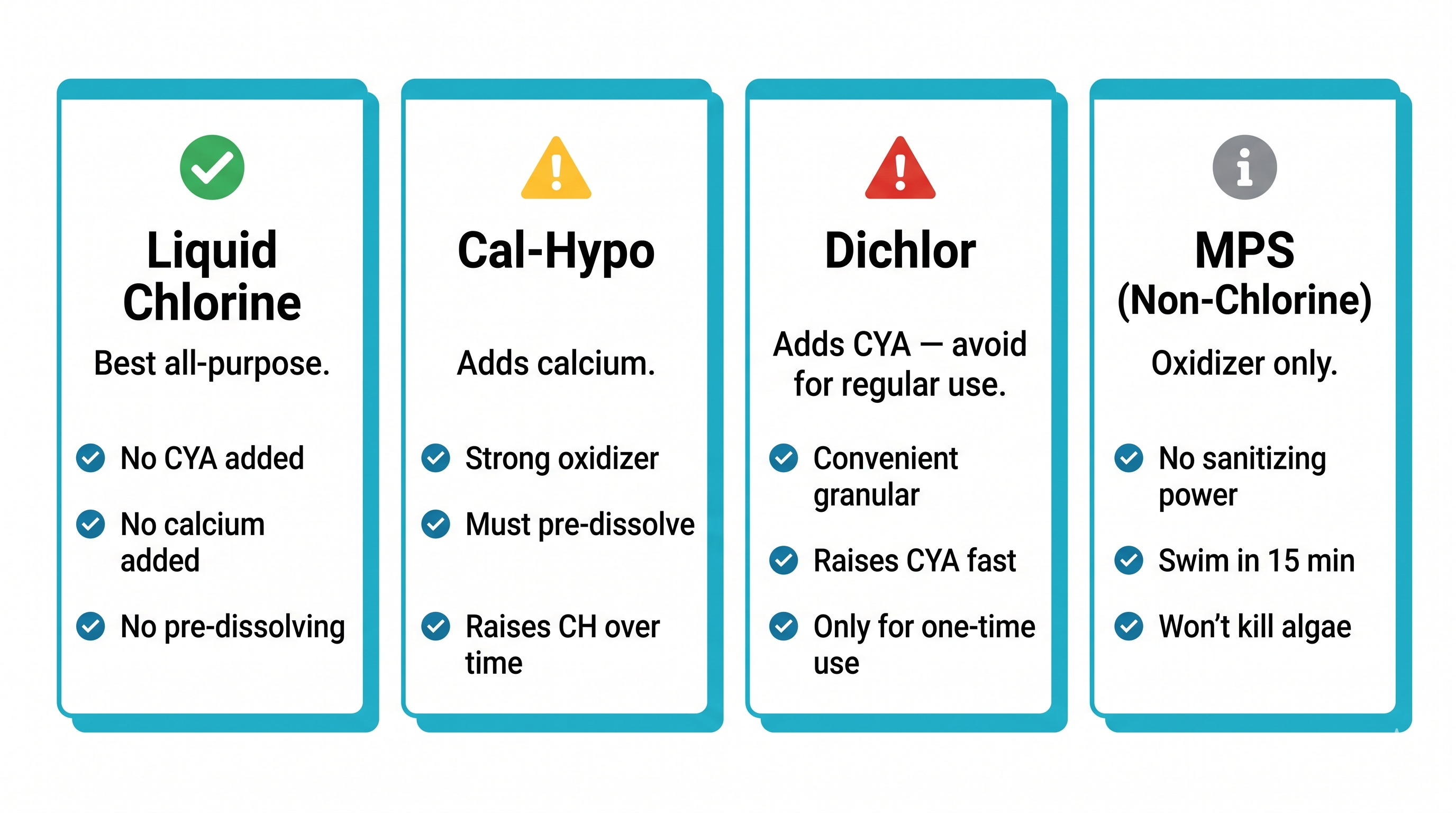
Liquid chlorine is the best general-purpose shock. It dissolves instantly, leaves no residue, and adds nothing but chlorine and a trace of salt to your water (the same salt an SWG uses if you ever convert the pool to saltwater). No CYA buildup, no calcium increase. The trade-off: it is heavy (a gallon weighs about 9 pounds), loses potency within weeks of manufacture, and needs upright storage in a cool space. Buy it fresh and use it promptly.
Calcium hypochlorite (cal-hypo) is the most common bagged shock at retail stores. It works well but raises calcium hardness with every dose. If your calcium is already above 300 ppm — common in hard-water regions — cal-hypo makes the problem worse. Always pre-dissolve cal-hypo in a bucket of pool water before adding it to the pool. Dumping granules directly can bleach vinyl liners and leave white staining on plaster surfaces.
Dichlor contains stabilizer. Every dose raises your CYA level. Shock with dichlor repeatedly through the season and CYA climbs while chlorine becomes progressively less effective — the exact opposite of what you want. For a detailed explanation of how CYA undermines chlorine, see CYA and chlorine: why your pool store gets it wrong. Dichlor is acceptable for small, infrequent doses in spas or above-ground pools. It should not be your routine shock for a full-size pool.
Non-chlorine shock (MPS) is an oxidizer, not a sanitizer. It eliminates chloramines and breaks down organic contaminants, but it cannot kill algae or bacteria. MPS is useful for a quick midweek oxidation when CC is mildly elevated, and you can swim about 15 minutes after adding it. If you have visible algae or a real contamination event, MPS will not help — you need chlorine.
How Much Shock to Add
Two numbers determine your dose: your current free chlorine and your target.
For breakpoint chlorination (eliminating chloramines): raise FC to approximately 10 times the CC reading above your current level. If CC is 1.0 ppm and current FC is 3 ppm, your target FC is about 13 ppm.
For algae treatment: your shock target depends entirely on your CYA level. At CYA 50, the target is 20 ppm FC. At CYA 80, it jumps to 31 ppm. Ignoring CYA is the most common reason people shock and nothing happens. The CYA-chlorine relationship determines how much shock you actually need — a generic "raise FC to 10 ppm" instruction falls short for any pool with meaningful CYA.
Test your current FC and CYA before adding anything. Then use this table to calculate how much chemical you need per 10,000 gallons.
Shock Dosage per 10,000 Gallons
| Chemical | Concentration | FC Rise per Unit | Amount for 10 ppm FC Rise |
|---|---|---|---|
| Liquid chlorine | 12.5% | ~9.4 ppm per gallon | 1.1 gallons |
| Liquid chlorine | 10% | ~7.5 ppm per gallon | 1.3 gallons |
| Household bleach | 6% | ~4.5 ppm per gallon | 2.2 gallons |
| Cal-hypo | 73% | ~8.7 ppm per pound | 1.1 lbs |
| Cal-hypo | 65% | ~7.5 ppm per pound | 1.3 lbs |
| Dichlor | 56% | ~6.7 ppm per pound | 1.5 lbs |
All amounts are per 10,000 gallons. Scale proportionally for your actual pool volume.
Example: Your pool is 15,000 gallons. CYA is 40, so your shock target is 16 ppm FC. Current FC reads 2 ppm. You need a 14 ppm rise. Using 12.5% liquid chlorine: 14 ÷ 9.4 = 1.49 gallons per 10,000 gallons, multiplied by 1.5 for your pool volume = 2.2 gallons.
The Pool app's dosage calculator handles this math — enter your volume, current readings, and shock type, and it returns the exact amount (iOS only). But the table above and a test kit are all you need to calculate by hand.
Always test before you dose. Never add shock based on a schedule or a guess. Test free chlorine and combined chlorine first. If FC is already at target and CC is below 0.5 ppm, your pool does not need shocking.
How to Shock Your Pool
-
Test the water. Measure FC, CC (or total chlorine — CC equals TC minus FC), pH, and CYA. All four readings inform your shock dose.
-
Lower pH if needed. Chlorine is far more effective at lower pH. At pH 7.2, about 66% of free chlorine is in the active hypochlorous acid form. At pH 8.0, only about 21% is active — roughly three times less killing power. If pH is above 7.6, bring it to 7.2–7.4 before shocking.
-
Calculate your dose. Determine your shock target (breakpoint or CYA-based) and use the dosage table. Scale for your pool volume.
-
Pre-dissolve granular shock. If using cal-hypo or dichlor, fill a 5-gallon bucket three-quarters full with pool water, then add the granules to the bucket. Stir until fully dissolved. Always add chemical to water — never pour water onto dry chemical.
-
Add shock at dusk. UV light destroys unstabilized chlorine within hours. Shocking in the evening gives chlorine a full night to work without solar degradation. Pools with adequate CYA (30–50 ppm) lose chlorine more slowly to sunlight, but evening dosing remains the better practice.
-
Pour with the pump running. For liquid chlorine, pour slowly in front of an active return jet. For pre-dissolved granular shock, pour the bucket around the pool perimeter. Do not pour directly onto steps, ladders, or into the skimmer.
-
Run the pump for at least 8 hours. Overnight is ideal. Circulation distributes chlorine evenly and prevents concentrated spots that can damage surfaces or bleach liners.
-
Retest before swimming. Do not estimate swim safety by the clock. Test free chlorine with strips or a liquid kit. Do not enter the pool until FC drops below 5 ppm.
Chemical safety is not optional. Wear chemical-resistant goggles and gloves when handling any pool shock product. Never mix chlorine-based shock with muriatic acid or any other pool chemical — the reaction can produce chlorine gas, which is lethal. Store shock in its original container, in a cool dry location, away from other chemicals and out of direct sunlight.
How Long After Shocking Can You Swim?
There is no universal hour count. It depends on how much you added and how quickly your pool breaks it down.
After a moderate oxidation shock (raising FC by 5–10 ppm), most pools with CYA of 30–50 ppm will drop below 5 ppm FC within 8–12 hours. After a heavy algae shock at SLAM levels (16–30+ ppm FC), it may take 24–48 hours or longer for FC to come down.
What speeds the decline: direct sunlight (especially in pools with low CYA), higher water temperature, and ongoing chlorine demand from organic contaminants. What slows it: higher CYA (stabilizes chlorine against UV breakdown), shade, and cooler water.
The only safe rule: test before you swim. If FC is below 5 ppm, go ahead. If not, wait a few hours and retest.
When Shocking Is Not Enough
If your pool is visibly green or has algae growing on surfaces, a single shock dose will not fix it. You need the SLAM process — Shock Level And Maintain — which means raising FC to the shock level for your CYA and holding it there for days, retesting and redosing every few hours, until the algae is dead and chlorine demand drops to near zero.
The type of algae affects your approach too. Green algae responds to SLAM with liquid chlorine. Yellow (mustard) algae requires higher sustained FC and aggressive brushing. Black algae has a protective outer layer that resists chlorine alone — it needs physical scrubbing and direct chemical application. For algae-specific treatment protocols, see pool algae treatment.
If you find yourself shocking more than twice a month, the real problem is not a lack of shock — it is your baseline maintenance. Your daily FC is probably too low for your CYA level, or CYA has crept too high for your chlorine regimen to keep up. Fix the underlying chemistry with a pool chemical calculator instead of treating the symptoms.
Frequently Asked Questions
How much shock do I need for my pool?
The amount depends on your pool volume, current free chlorine, and target shock level. As a baseline, 1 pound of 65% calcium hypochlorite raises FC by approximately 7.5 ppm per 10,000 gallons. For 10% liquid chlorine, 1 gallon raises FC by about 7.5 ppm per 10,000 gallons. Test your current FC and CYA first, then calculate the gap between your reading and your shock target.
How long after shocking a pool can I swim?
Do not swim until free chlorine drops below 5 ppm — test with strips or a liquid kit before entering. After a moderate shock dose, FC typically falls below 5 ppm within 8–24 hours depending on sunlight, water temperature, and CYA level. Never estimate swim safety based on time alone.
When should I shock my pool?
Shock when your pool has a specific trigger: combined chlorine above 0.5 ppm, after heavy use with 6–8 or more swimmers, after a rainstorm, when water appears cloudy or green, or when opening the pool for the season. If you maintain adequate daily free chlorine relative to your CYA level, weekly shocking is unnecessary.
What is the best type of pool shock?
Liquid chlorine (sodium hypochlorite at 10–12.5%) is the best all-purpose shock for residential pools. It dissolves instantly, adds no CYA or calcium, and is easy to dose precisely. Cal-hypo is a good backup for occasional use but raises calcium hardness and must be pre-dissolved. Avoid dichlor for regular shocking — it raises CYA.
Can I use regular bleach to shock my pool?
Yes. Unscented household bleach is sodium hypochlorite at 6–8.25% — the same active ingredient as pool-grade liquid chlorine, just more dilute. One gallon of 6% bleach raises FC by about 4.5 ppm per 10,000 gallons. You need roughly twice the volume compared to 12.5% pool-grade liquid chlorine to achieve the same FC rise.
Do I need to shock my pool every week?
No. Weekly shocking is unnecessary if your free chlorine stays above the minimum for your CYA level and combined chlorine stays below 0.5 ppm. A well-maintained residential pool typically needs shocking 4–6 times per season — after storms, heavy use, or when test results show chloramine buildup. Routine shocking without a specific trigger wastes chemicals and money.
Frequently Asked Questions
Vlad Kuzin
Founder of Poolably. Building the most practical pool chemistry calculator on iOS.